Artwork story
About The Falls of Niagara
The artist and artwork
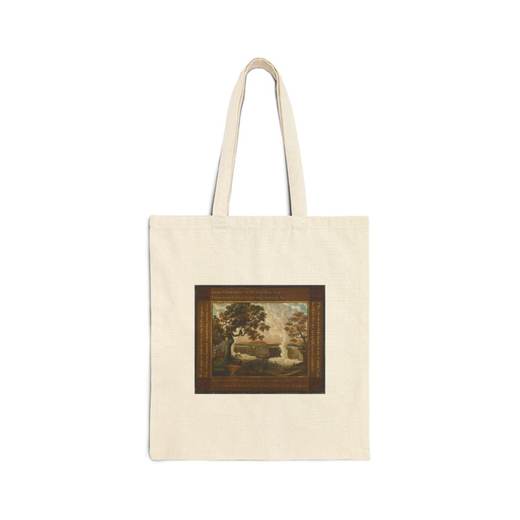
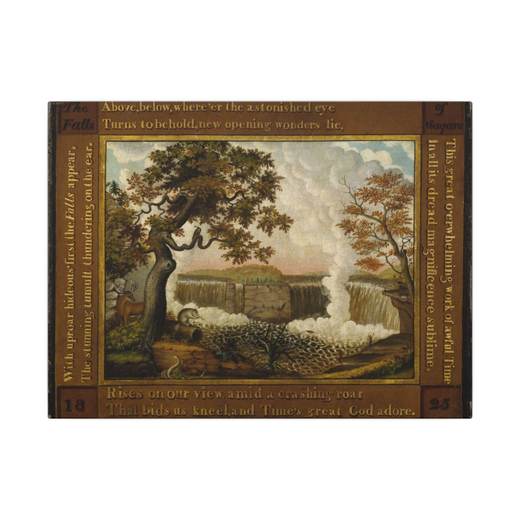
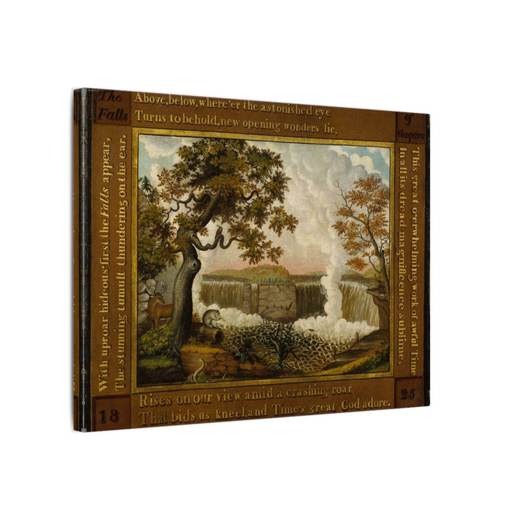
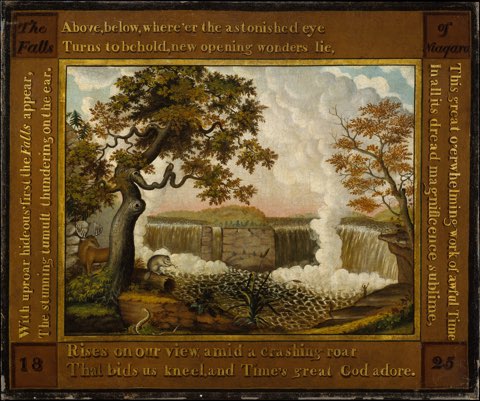
Edward Hicks painted The Falls of Niagara around 1825 as an oil-on-canvas landscape that is also a carefully framed meditation. Hicks was a Quaker minister who had learned decorative painting through coach and sign work. Inside the border, sheets of water descend into a basin of spray while trees and animals occupy the near banks. Hicks organizes a vast, noisy place into a clear image that can be read almost like a sermon.
The world around it
Hicks made the painting during the early United States republic, when maps, prints, canals, and travel writing were changing how people encountered distant places. He had seen Niagara Falls in 1819 during a missionary journey in upstate New York. In 1825, the Erie Canal opened a route between the Hudson River and Lake Erie, accelerating travel, commerce, and settler movement across New York. The scene also reflects a Euro-American habit of treating animals and landscapes as symbols of a newly claimed continent, a framing that leaves Indigenous relationships to the region outside the picture.
A detail to notice
A painter who had visited Niagara did not simply recreate an on-site sketch. The Met identifies an engraving on an 1822 map of North America as the source for his view from the Canadian side. Hicks then added a moose, beaver, rattlesnake, and eagle, familiar Euro-American emblems of North America, and painted a poem by Alexander Wilson around the image. The verse turns the border into part of the subject: the spectacle of falling water becomes an argument about divine power. The composition asks the eye to move between a landscape, a map-derived image, and a religious interpretation rather than treating the falls as a neutral scenic postcard.
Look closer: materials, scale, and subjects
The recorded object is painting made in Oil on canvas and held in The American Wing.
Recorded dimensions include 31 1/2 x 38 in. (80 x 96.5 cm).
Subject terms include Animals, Eagles, Snakes, Waterfalls, and Trees. Treat them as guideposts, not a complete interpretation.
Collection history and public-domain source
The collection credit line is Gift of Edgar William and Bernice Chrysler Garbisch, 1962.
The individual artwork page and official image were verified as Public Domain on 2026-08-23.
No Context Gallery independently uses the public-domain image. The source museum has not endorsed, sponsored, or affiliated itself with these products.
Research sources
See the products currently available with this artwork. Product choices appear only when the exact item is published, in stock, and available to purchase.