Artwork story
About The Toilers of the Sea
The artist and artwork
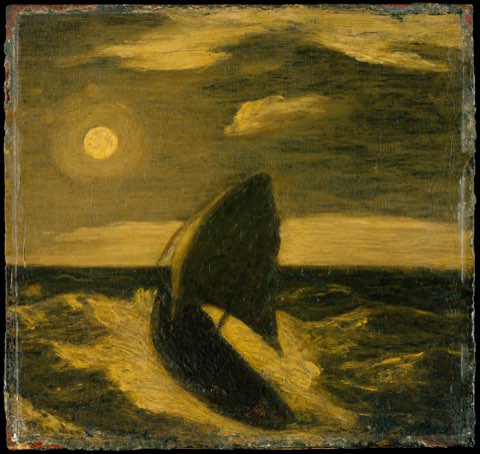
Albert Pinkham Ryder painted The Toilers of the Sea around 1880–85 in oil on a wood panel only eleven and a half by twelve inches. Raised in the whaling port of New Bedford, Massachusetts, he remained drawn to marine subjects after moving to New York City in 1870. Ryder worked from observed nature but also turned literature into landscape. The Met says this picture may relate to Victor Hugo's 1866 novel of the same name; the connection is possible, not certain.
The world around it
The small panel emerged during the Gilded Age, when post-Civil-War New York was rapidly building the institutions, patron networks, and markets of a modern art world. The Met's history of New York's 1870–90 art worlds describes profound socioeconomic change, artists marketing work to elite and middle-class patrons, European training alongside local academies, and new venues including the Art Students League and Society of American Artists. Ryder's simplified, imaginative marine did not describe a specific harbor. It placed private observation and literary suggestion inside that expanding art market while turning moon, sail, and water into concentrated masses and movement.
A detail to notice
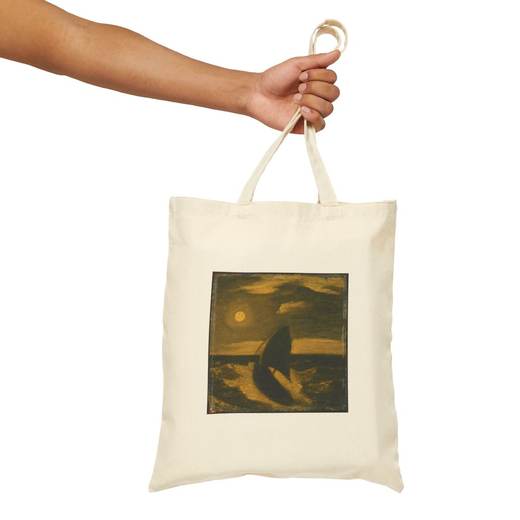
A low yellow moon hangs at left while one dark sail rises like a wedge from a small boat pitching toward the viewer. No sailor is clearly visible. Ryder makes the vessel feel inhabited through its struggle with the water, letting the title's toilers remain almost swallowed by sea and night. A sea-captain friend remembered Ryder studying moonlight on the Hudson River, but the surface is as important as the subject. Ryder built pigment in unusually thick layers; over time they cracked and altered the contours of clouds, sail, and hull. The Met still calls the result gemlike and haunting, while warning that the surface we see now has changed since Ryder painted it.
Look closer: materials, scale, and subjects
The recorded object is painting made in Oil on wood and held in The American Wing.
Recorded dimensions include 11 1/2 x 12 in. (29.2 x 30.5 cm).
Subject terms include Seascapes and Boats. Treat them as guideposts, not a complete interpretation.
Collection history and public-domain source
The collection credit line is George A. Hearn Fund, 1915.
The individual artwork page and official image were verified as Public Domain on 2026-08-23.
No Context Gallery independently uses the public-domain image. The source museum has not endorsed, sponsored, or affiliated itself with these products.
Research sources
See the products currently available with this artwork. Product choices appear only when the exact item is published, in stock, and available to purchase.