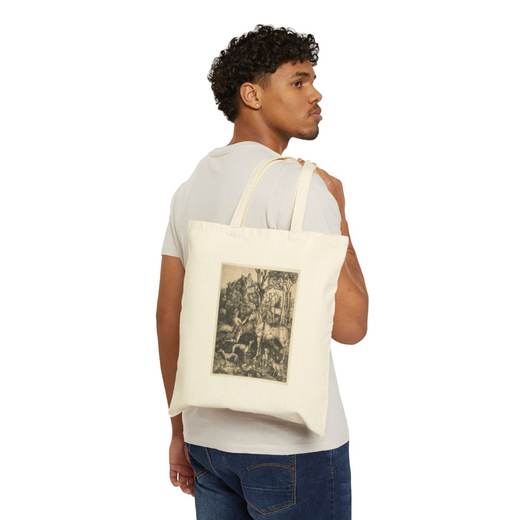
Artwork story
About Saint Eustace
The artist and artwork
Albrecht Dürer made Saint Eustace in Nuremberg around 1501 as an engraving, cutting the image into a copper plate so ink held in the incised lines could be transferred to paper. Trained first in his goldsmith father's workshop, Dürer brought a metalworker's control to printmaking and helped establish it as an independent fine art. This was his largest engraving. It depicts the conversion of the Roman general Placidus, who sees a crucifix miraculously appear between a stag's antlers while hunting, hears Christ's voice, kneels, and is later baptized Eustace.
The world around it
The print emerged from Nuremberg, one of northern Europe's strongest commercial and artistic centers, just after Dürer had become internationally famous through his 1498 Apocalypse woodcuts. Prints could cross borders more readily than paintings, carrying his monogram and inventions to artists and collectors throughout German-speaking lands and across the Alps. Saint Eustace appeared before the Protestant Reformation divided Christianity, in a Holy Roman Empire where cities, humanist learning, religious devotion, and expanding print commerce met.
A detail to notice
The miracle is almost hidden inside a hunting world rendered with obsessive clarity. Eustace kneels at lower left, but his bridled horse occupies the center and five alert dogs spread across the foreground in distinct poses. The stag stands beyond them with the tiny crucifix suspended between enormous antlers. A stream and stone bridge lead the eye past the figures toward a castle improbably stacked on a crag, while two monumental trees bind foreground and distance. Dürer's `AD` monogram sits like a small tablet at the bottom. The Met notes that the animals and landscape features became models for artists for the next century; one surviving sixteenth-century study even traces and painstakingly copies this composition. Its influence makes sense: the viewer discovers the sacred event by searching through fur, bark, water, rock, architecture, and miles of imagined space, so close looking reenacts the hunter's sudden recognition.
Look closer: materials, scale, and subjects
The recorded object is print made in Engraving and held in the Drawings and Prints department.
Recorded dimensions include Sheet: 13 3/4 × 10 3/16 in. (35 × 25.9 cm).
Subject terms include Men, Deer, Dogs, Horses, Landscapes, and Crucifixion. Treat them as guideposts, not a complete interpretation.
Collection history and public-domain source
The collection credit line is Fletcher Fund, 1919.
The individual artwork page and official image were verified as Public Domain on 2026-08-23.
No Context Gallery independently uses the public-domain image. The source museum has not endorsed, sponsored, or affiliated itself with these products.
Research sources
See the products currently available with this artwork. Product choices appear only when the exact item is published, in stock, and available to purchase.