Artwork story
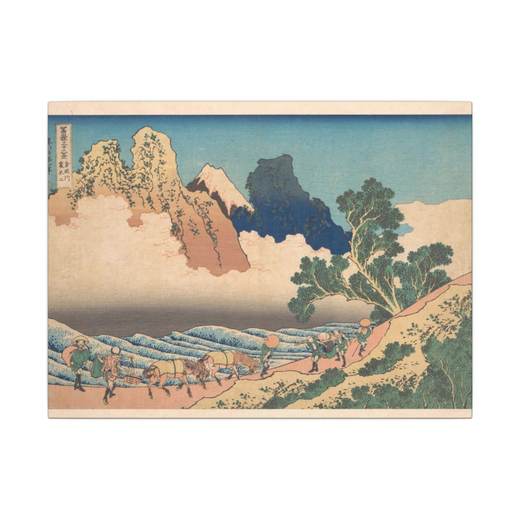
About View from the Other Side of Fuji from the Minobu River (Minobugawa ura Fuji), from the series Thirty-six Views of Mount Fuji (Fugaku sanjūrokkei)
The artist and artwork
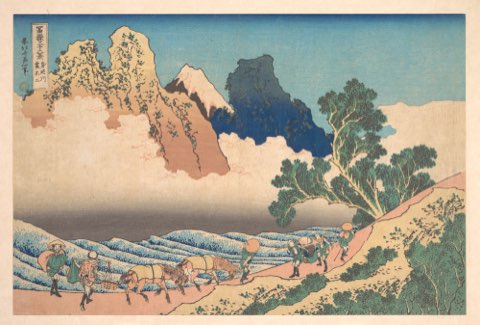
Katsushika Hokusai designed View from the Other Side of Fuji from the Minobu River around 1830–32 as part of his Thirty-six Views of Mount Fuji. Working in the Edo period and already about seventy years old, he used the reproducible woodblock-print format to make changing encounters with one mountain the basis of an extended series. Ink and color define a small sheet less than ten inches high, yet sharp silhouettes, overlapping planes, and unusually bold scale shifts make the terrain feel immense.
The world around it
The series belongs to the late Edo period, when views of travel, work, famous places, and seasonal experience circulated through a thriving urban print culture. Fuji was both a physical landmark and a sacred, nationally resonant presence. Across the series, Hokusai shows it beside city crowds, fishermen, craftsmen, travelers, storms, lakes, and distant roads. The Met notes that the original project caused such a sensation that its publisher expanded the nominal thirty-six views to forty-six. Repetition did not make Fuji static; each sheet tested a new relationship between enduring mountain and passing human activity.
A detail to notice
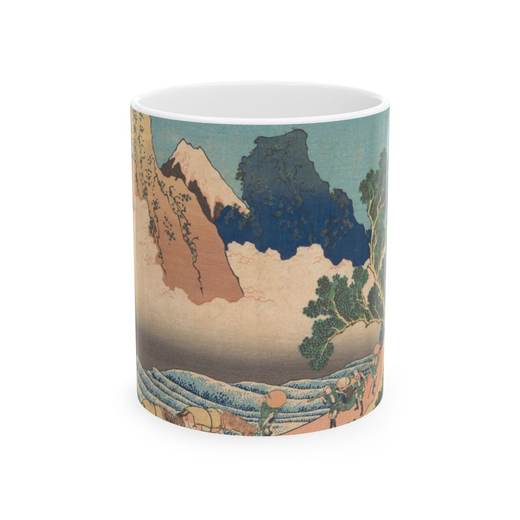
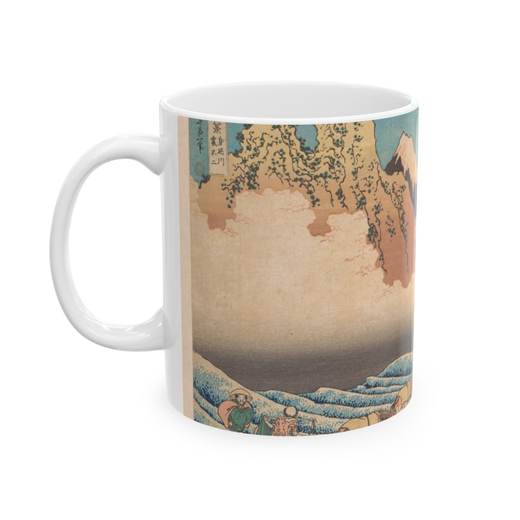
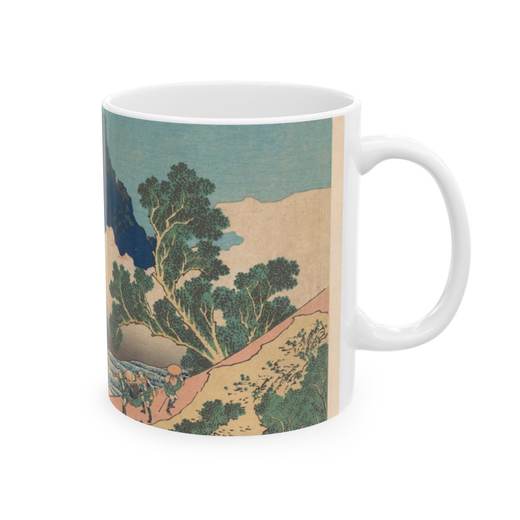
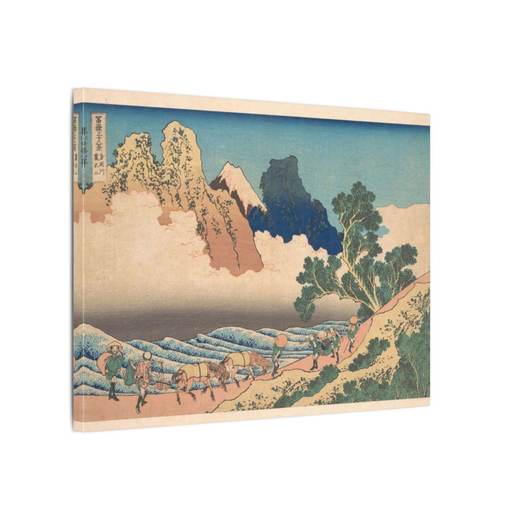
Fuji is not the largest peak here. Its pale, snow-streaked triangle appears near the upper center, squeezed between jagged tan cliffs and a dark blue mass that rises higher. Far below, travelers and two loaded horses follow a salmon-colored road from left to right, then climb sharply beneath a spreading tree. Their bent bodies, staffs, hats, and baggage create a slow procession through the landscape. Bands of mist erase the bases of the mountains, so the peaks seem to float while the road remains tangible. Hokusai makes the famous cone something discovered rather than announced: the eye follows the caravan, leaps through cloud, and only then recognizes Fuji among its rougher neighbors.
Look closer: materials, scale, and subjects
The recorded object is woodblock print made in Woodblock print; ink and color on paper and held in the Asian Art department.
Recorded dimensions include 9 7/8 x 14 3/4 in. (25.1 x 37.5 cm).
Subject terms include Men, Horses, Mountains, Landscapes, and Trees. Treat them as guideposts, not a complete interpretation.
Collection history and public-domain source
The collection credit line is Rogers Fund, 1914.
The individual artwork page and official image were verified as Public Domain on 2026-08-23.
No Context Gallery independently uses the public-domain image. The source museum has not endorsed, sponsored, or affiliated itself with these products.
Research sources
See the products currently available with this artwork. Product choices appear only when the exact item is published, in stock, and available to purchase.