Artwork story
About The Stag-Hunt
The artist and artwork
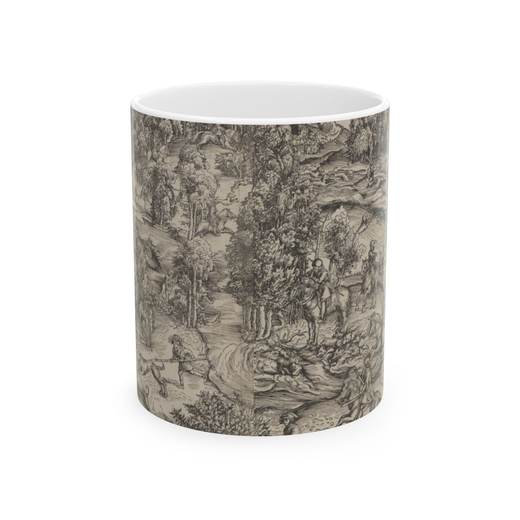
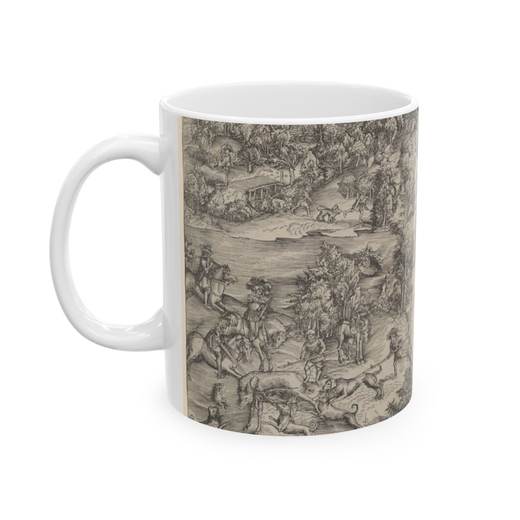
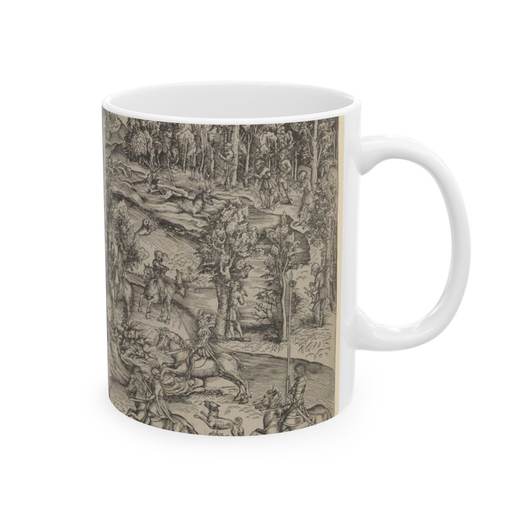
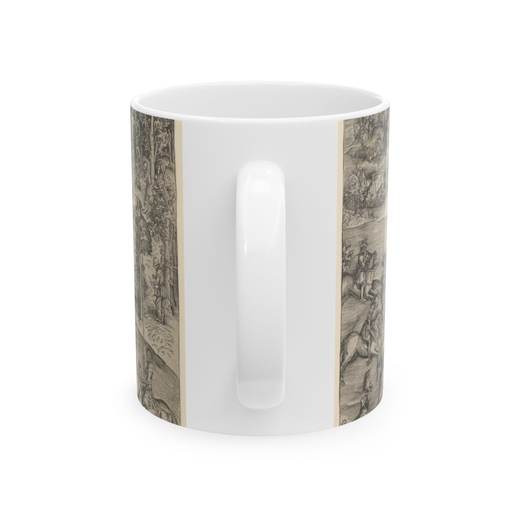
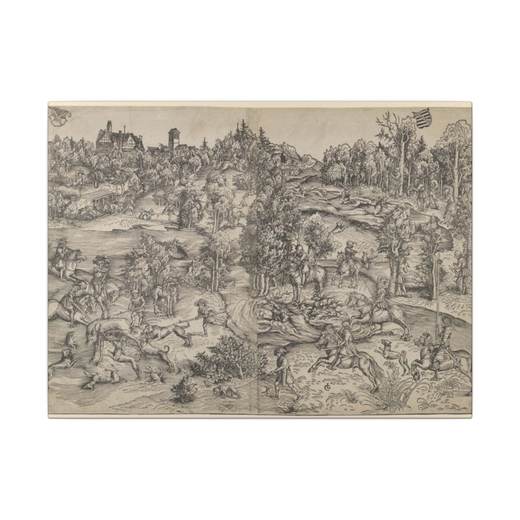
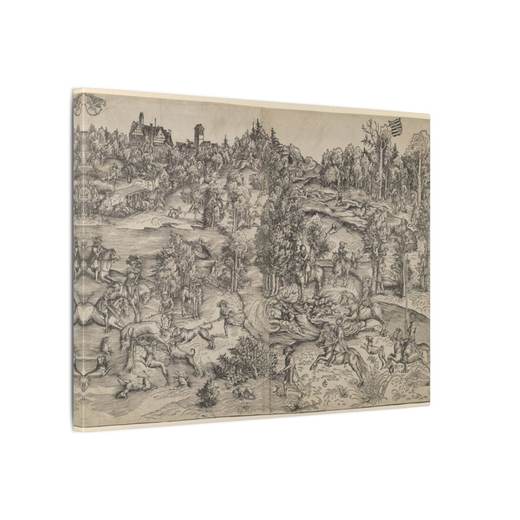
Lucas Cranach the Elder cut The Stag-Hunt into two adjoining woodblocks in 1506; The Met's impression is the second of two states. It was his earliest and largest hunting print. Cranach had entered the service of Frederick the Wise, Elector of Saxony, in Wittenberg by 1505. As court artist he joined the elector's hunts with a sketchbook and became celebrated for animals and hunting scenes. Here, carved black lines multiply into wooded hills, water, buildings, riders, hounds, and deer across a broad sheet whose joined blocks turn one print into a panoramic field of action.
The world around it
The work predates Luther's Ninety-five Theses by eleven years, so its Saxon court setting is not yet the Reformation partnership for which Cranach later became famous. It records aristocratic hunting as both sport and display: Frederick's lodges, mounted entourage, trained dogs, weapons, and heraldry organize managed land around the ruler. Two Saxon arms hover over the panorama, and the distant lodge is probably Lochau Castle. Crossbows served nobles and commoners in hunting, and one rider uses a compact cranequin, a geared winder that could span the powerful bow while mounted. Reproducible woodcut carries this exclusive court event beyond the hunt itself.
A detail to notice
There is no single frozen climax. The Met directs the eye clockwise from upper left, where dogs begin the chase, through deer running across ridges and water, to the stag's death at lower left, possibly by Frederick's own hand. Elsewhere hunters reload, sound horns, hold hounds, wade, ride, and wait beside already fallen animals. A castle, church, bridges, boats, and tiny settlements keep the landscape inhabited. Cranach's `LC` monogram sits low near center, but the two crests float much higher. The print makes looking resemble hunting: trees repeatedly conceal the quarry, and the viewer must track separate episodes through one continuous, crowded terrain.
Look closer: materials, scale, and subjects
The recorded object is print made in Woodcut; second state of two (Hollstein) and held in the Drawings and Prints department.
Recorded dimensions include Sheet: 5 9/16 × 7 13/16 in. (14.2 × 19.9 cm).
Subject terms include Soldiers, Weapons, Men, Hunting, Deer, and Dogs. Treat them as guideposts, not a complete interpretation.
Collection history and public-domain source
The collection credit line is Rogers Fund, 1922.
The individual artwork page and official image were verified as Public Domain on 2026-08-23.
No Context Gallery independently uses the public-domain image. The source museum has not endorsed, sponsored, or affiliated itself with these products.
Research sources
See the products currently available with this artwork. Product choices appear only when the exact item is published, in stock, and available to purchase.