Artwork story
About The Love Song
The artist and artwork
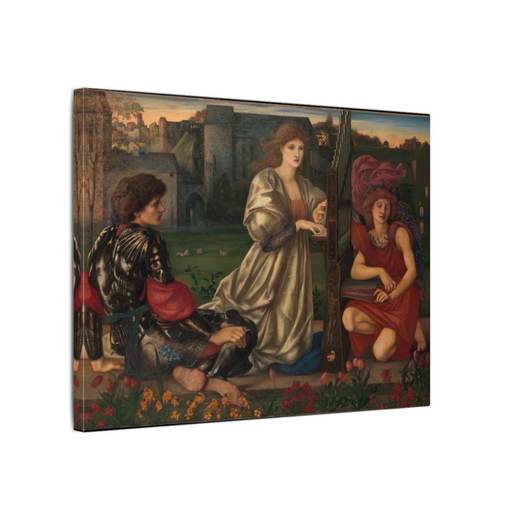
Edward Burne-Jones painted The Love Song over nine years, from 1868 to 1877, in oil on canvas. He had begun as an Oxford theology student before choosing art, learning from Dante Gabriel Rossetti and becoming a leading figure in the second generation of the Pre-Raphaelites. Burne-Jones also designed for Morris & Company, so painting, music, poetry, and decorative craft regularly met in his work. This final version of several related compositions was inspired by the refrain of an old Breton song; Burne-Jones called the subject Chant d'Amour, making music itself part of the painting's idea.
The world around it
The picture emerged in Victorian Britain during the Industrial Revolution, when mass production was transforming work and daily life. Burne-Jones and his friend William Morris answered that world by looking toward medieval workshop practice and by joining fine and applied art. The Love Song belongs to the Aesthetic movement's pursuit of beauty, mood, and suggestion rather than a plainly stated moral. Its dreamlike medieval setting combines Gothic and early Italian Renaissance influences with Pre-Raphaelite color. When Burne-Jones showed it with eight other works at London's Grosvenor Gallery in 1878, that alternative to the Royal Academy helped establish his public success.
A detail to notice
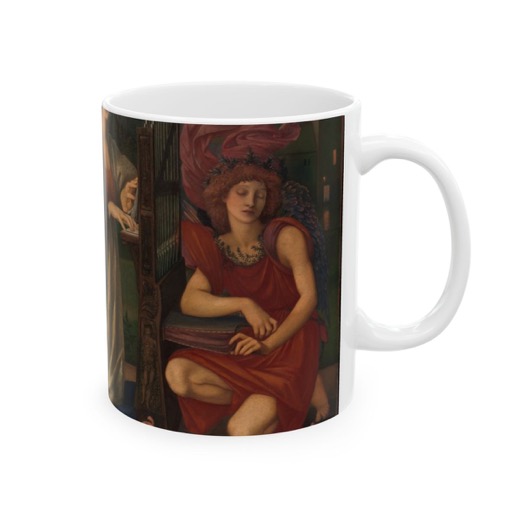
The three figures are close together but emotionally separate. At left, an armored yet barefoot young lover holds his helmet and looks toward the woman. She plays a small portable organ while staring beyond him, and the red-clad Cupid who works the instrument's bellows keeps his eyes closed; arrows rise behind his shoulder. Burne-Jones described the figures as joined by mutual indifference. Tulips and other flowers form a carpet-like foreground and carry associations of bitterness and love, while a quiet medieval town recedes into dusk. The painting never resolves whether its song is sad or happy, turning frustrated attention, withheld eye contact, and suspended music into its real drama.
Look closer: materials, scale, and subjects
The recorded object is painting made in Oil on canvas and held in the European Paintings department.
Recorded dimensions include 45 x 61 3/8 in. (114.3 x 155.9 cm).
Subject terms include Musical Instruments, Armor, Men, and Women. Treat them as guideposts, not a complete interpretation.
Collection history and public-domain source
The collection credit line is The Alfred N. Punnett Endowment Fund, 1947.
The individual artwork page and official image were verified as Public Domain on 2026-08-23.
No Context Gallery independently uses the public-domain image. The source museum has not endorsed, sponsored, or affiliated itself with these products.
Research sources
See the products currently available with this artwork. Product choices appear only when the exact item is published, in stock, and available to purchase.