Artwork story
About Leatherstocking's Rescue
The artist and artwork
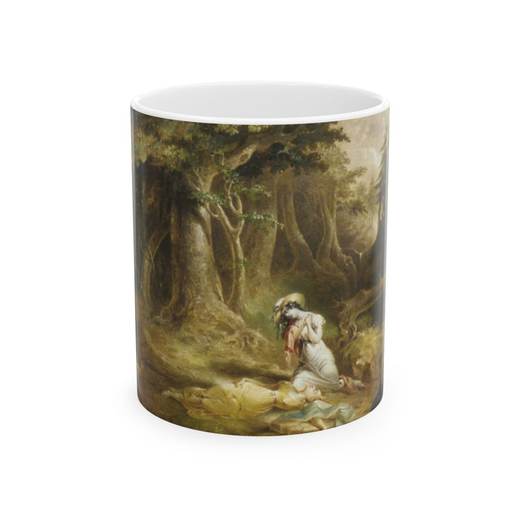
John Quidor painted Leatherstocking's Rescue in 1832, translating a dramatic passage from James Fenimore Cooper's novel The Pioneers into oil on canvas. Quidor is better known for pictures based on Washington Irving, but this work shows his attraction to another popular American writer. Instead of treating the forest as observed topography, he bends landscape, animals, and human bodies toward storytelling. Twisted trunks, theatrical gestures, concentrated light, and dark recesses make the literary episode feel like a vision unfolding on a stage.
The world around it
Cooper published The Pioneers in 1823, introducing the woodsman Natty Bumppo, also called Leatherstocking, in the first-written of five novels about the character. Quidor's picture followed nine years later, during the Jacksonian era, when American writers and artists were searching for subjects identified with the young republic. The Met's Hudson River School history notes that Cooper's Leatherstocking novels helped make wilderness a major theme in American culture. Quidor used that native literature differently from landscape painters: the forest becomes a charged setting for horror, rescue, and conflict between human settlement and untamed nature.
A detail to notice
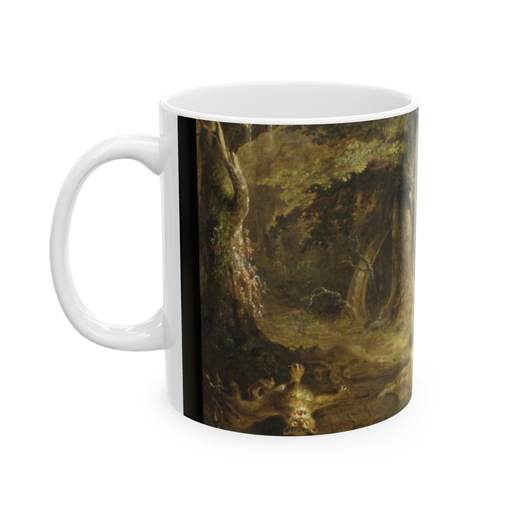
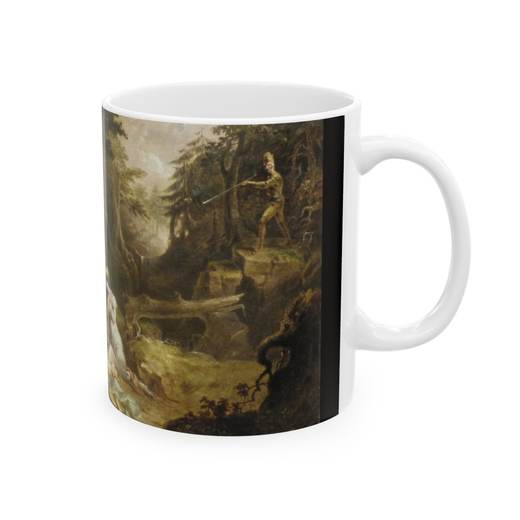
The story's danger is distributed around the edges. A female panther crouches in shadow at the far right after killing the dog that lies overturned at lower left; between them, two young women form the painting's bright center, one collapsed and the other bending over her. Leatherstocking stands high on a ledge at upper right, his long rifle aimed diagonally into the scene. That distance delays the rescue and makes the women appear exposed. Even the trees participate: broken limbs resemble claws, roots twist like bodies, and a pale opening in the woods creates an uncertain escape route. Quidor intensifies Cooper's episode by making the entire forest seem predatory, not merely the animal within it.
Look closer: materials, scale, and subjects
The recorded object is painting made in Oil on canvas and held in The American Wing.
Recorded dimensions include 26 x 34 in. (66 x 86.4 cm).
Subject terms include Animals, Men, Women, and Dogs. Treat them as guideposts, not a complete interpretation.
Collection history and public-domain source
The collection credit line is Gift of Erving Wolf Foundation, in memory of Diane R. Wolf, 1978.
The individual artwork page and official image were verified as Public Domain on 2026-08-23.
No Context Gallery independently uses the public-domain image. The source museum has not endorsed, sponsored, or affiliated itself with these products.
Research sources
See the products currently available with this artwork. Product choices appear only when the exact item is published, in stock, and available to purchase.