Artwork story
About Dune Landscape with Oak Tree
The artist and artwork
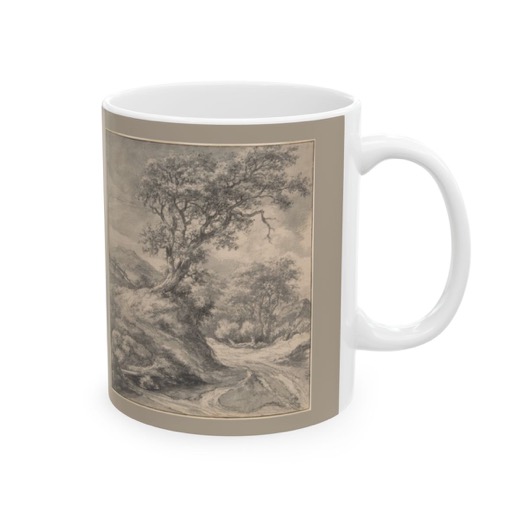
Jacob van Ruisdael made Dune Landscape with Oak Tree around 1650–55 using black chalk, brush, gray wash, and gouache, then enclosed the image with pen-and-ink framing lines. The sheet is only eight and one-quarter by seven and one-half inches, yet the oak rises like a monument from the dune. A stream trickles through the gully, a small footbridge crosses it, and a thatched hut settles into the trees. Ruisdael used a restrained gray vocabulary to build foliage, light, air, and deep space.
The world around it
Landscape flourished as an independent genre in the seventeenth-century Dutch Republic. Holland was intensely urban, by one estimate, as much as seventy percent of its population lived in cities and towns, and mercantile and professional buyers developed a taste for countryside imagery. Such works could evoke local pride, agriculture, travel, leisure, weather, and the pleasure of stepping outside the city. Drawings were especially open to experiment because they cost less and were viewed more privately than paintings. Ruisdael, born in Haarlem, became the century's most influential Dutch landscapist.
A detail to notice
This was probably not a casual study for some later painting. Ruisdael monogrammed the highly finished sheet, evidence that it had independent status as a completed work. Its cleverest effect is the exchange of scale: a pocket-size page makes one oak feel heroic. The high background dunes enlarge that impression, while the hut and footbridge quietly return the scene to human dimensions. A light chalk beginning becomes solid atmosphere through layered semi-opaque washes; pale paper serves as illumination, while dense marks root the tree. The drawing is small enough to hold but composed to feel too large to contain.
Look closer: materials, scale, and subjects
The recorded object is drawing made in Black chalk, brush and gray wash, and gouache; framing lines in pen and brown ink and held in the Drawings and Prints department.
Recorded dimensions include 8 1/4 x 7 1/2 in. (21.0 x 19.1 cm).
Subject terms include Landscapes, Oaks, and Trees. Treat them as guideposts, not a complete interpretation.
Collection history and public-domain source
The collection credit line is Fletcher Fund, 1995.
The individual artwork page and official image were verified as Public Domain on 2026-08-23.
No Context Gallery independently uses the public-domain image. The source museum has not endorsed, sponsored, or affiliated itself with these products.
Research sources
See the products currently available with this artwork. Product choices appear only when the exact item is published, in stock, and available to purchase.