Artwork story
About Saint Eustace
The artist and artwork
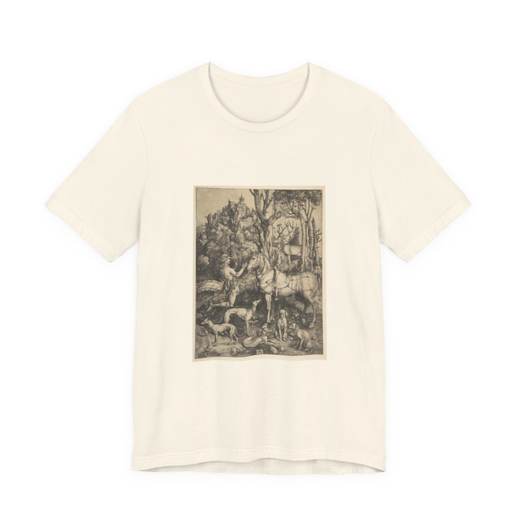
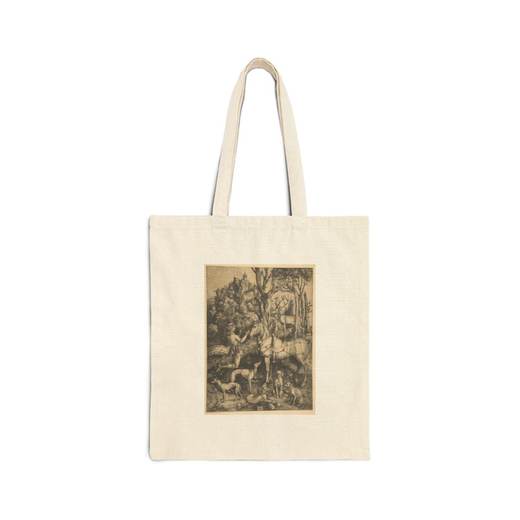
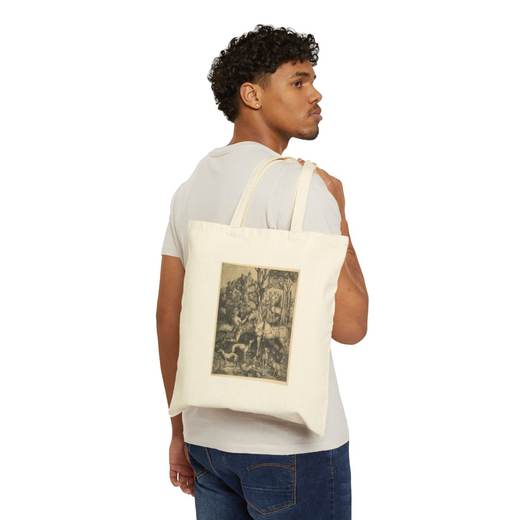
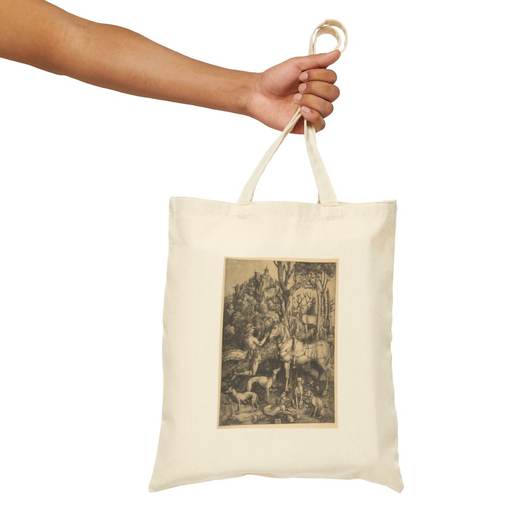
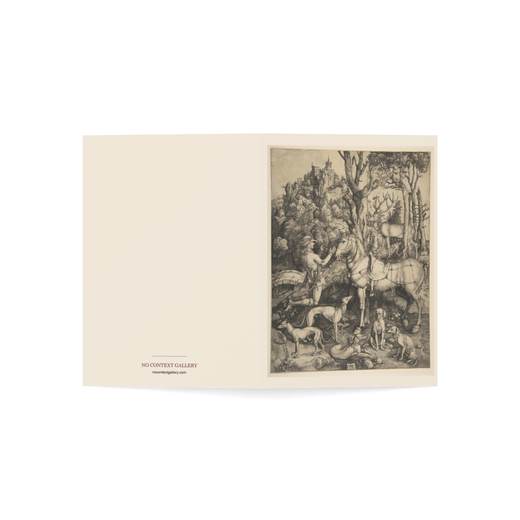
Albrecht Dürer engraved Saint Eustace around 1501, turning a sheet just under fourteen inches high into a complete world. A hunter kneels beside his horse, a stag waits across the stream, dogs crowd the foreground, and a rocky castle rises through the trees. The legend tells of Placidus, a Roman general who saw a crucifix between a stag's antlers while hunting, heard Christ's voice, and converted under the name Eustace. Dürer built fur, bark, stone, water, and distance from networks of incised lines, hatching, and cross-hatching.
The world around it
Dürer worked in Nuremberg, a major commercial and artistic center at the opening of the sixteenth century. He trained in his goldsmith father's workshop and then with painter and printmaker Michael Wolgemut. Travel through the Upper Rhineland and Italy widened his visual vocabulary. After returning as a master in 1495, he used prints to carry his reputation far beyond the city; his Apocalypse woodcuts appeared in 1498. Multiple impressions could cross borders and reach collectors and workshops unlike a single painting. Dürer helped make printmaking an independent, ambitious art form.
A detail to notice
The miracle is almost the easiest thing to miss. The horse dominates the center, and the dogs pose, sniff, twist, and wait so individually that the eye may linger among them before finding the tiny crucifix between the stag's antlers at upper right. The kneeling hunter marks the instant when pursuit becomes conversion, but every root, cliff, branch, and animal keeps its physical presence. The Met calls Saint Eustace Dürer's largest engraving and notes that its animals and landscape features became models for artists for the following century. A later workshop drawing in the collection preserves the work of copying the print line by line. The sacred sign arrives in miniature while exact observation makes the surrounding world feel enormous and portable.
Look closer: materials, scale, and subjects
The recorded object is print made in Engraving and held in the Drawings and Prints department.
Recorded dimensions include Sheet: 13 15/16 × 10 1/4 in. (35.4 × 26.1 cm).
Subject terms include Men, Deer, Dogs, Horses, Landscapes, and Saints. Treat them as guideposts, not a complete interpretation.
Collection history and public-domain source
The collection credit line is Harris Brisbane Dick Fund, 1917.
The individual artwork page and official image were verified as Public Domain on 2026-08-23.
No Context Gallery independently uses the public-domain image. The source museum has not endorsed, sponsored, or affiliated itself with these products.
Research sources
See the products currently available with this artwork. Product choices appear only when the exact item is published, in stock, and available to purchase.