Artwork story
About Ia Orana Maria (Hail Mary)
The artist and artwork
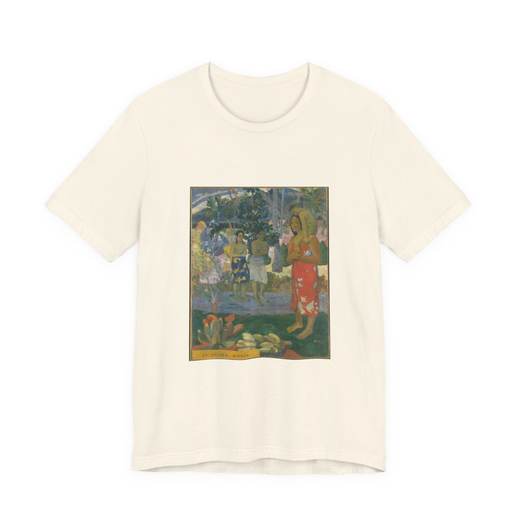
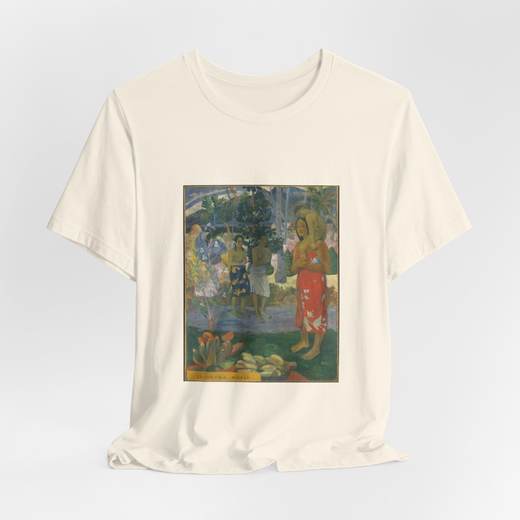
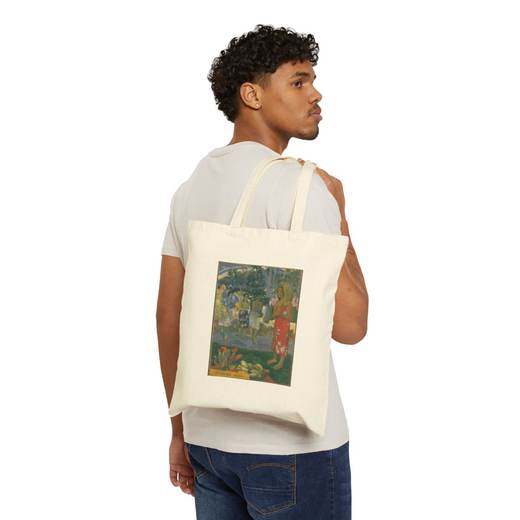
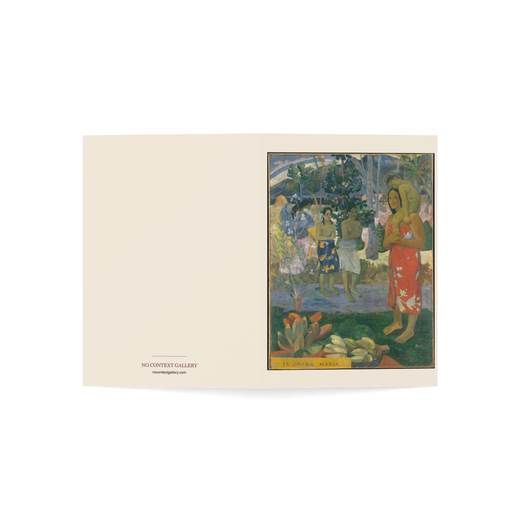
Paul Gauguin painted Ia Orana Maria (Hail Mary) in 1891 as a large oil on canvas soon after reaching Tahiti. His first major Tahitian painting predates his sustained use of Polynesian religious subjects. Here he recasts Christian imagery: Mary stands at right with the Christ Child on her shoulder, two women greet them with folded hands, and a partly hidden angel announces the encounter. Broad color fields and firm outlines make the scene both landscape and emblem.
The world around it
Gauguin sailed from France in 1891 seeking an imagined exotic, preindustrial escape. Colonial displays at the 1889 Paris Exposition Universelle had encouraged the idea. Tahiti therefore entered his work through an unequal colonial encounter, not as the untouched paradise he promoted to European audiences. Gauguin was also moving beyond Impressionism toward Symbolism, using invented color and simplified form to express memory, religion, and emotion rather than an optical record. This is a European artist's constructed synthesis, not a documentary account of Tahitian spiritual life.
A detail to notice
The title painted across the lower-left border is Tahitian: Ia Orana Maria means 'Hail Mary', the angel Gabriel's greeting at the Annunciation. Yet the composition reaches beyond Europe or Tahiti. Gauguin based the two central worshippers on a photograph he owned of a relief at the Buddhist temple of Borobudur in Java. The result joins a Christian story, Polynesian figures and pareus, and a photographed Indonesian source. Yellow wings almost disappear behind the flowering tree at left; yellow halos identify mother and child at right; bananas and other fruit sit like offerings at the front. The flat red dress, violet path, green foreground, and dark mountains bind the borrowed elements into one decorative surface. The painting's beauty comes from that synthesis, while its sources reveal how much of Gauguin's imagined Tahiti traveled there with him.
Look closer: materials, scale, and subjects
The recorded object is painting made in Oil on canvas and held in the European Paintings department.
Recorded dimensions include 44 3/4 x 34 1/2 in. (113.7 x 87.6 cm).
Subject terms include Women, Landscapes, Angels, Virgin Mary, and Jesus. Treat them as guideposts, not a complete interpretation.
Collection history and public-domain source
The collection credit line is Bequest of Sam A. Lewisohn, 1951.
The individual artwork page and official image were verified as Public Domain on 2026-08-23.
No Context Gallery independently uses the public-domain image. The source museum has not endorsed, sponsored, or affiliated itself with these products.
Research sources
See the products currently available with this artwork. Product choices appear only when the exact item is published, in stock, and available to purchase.