Artwork story
About The Crucifixion with the Virgin and Saint John
The artist and artwork
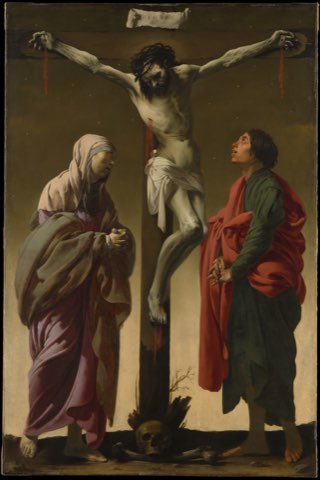
Hendrick ter Brugghen painted The Crucifixion with the Virgin and Saint John around 1624–25 in oil on canvas. The tall work was designed as an altarpiece, probably for a Catholic church in Utrecht and perhaps to replace an earlier image that had been damaged or destroyed. Ter Brugghen belonged to Utrecht's younger generation of artists who absorbed Caravaggio's close figures, strong light, and physical immediacy. Here he joined that modern naturalism to deliberately archaic features recalling late medieval woodcuts, Dürer's prints, and Grünewald's Isenheim Altarpiece.
The world around it
The painting emerged in the Dutch Republic, where Calvinist authorities had removed many altarpieces and sculptures from former Catholic churches. Catholic worship continued, but in Utrecht it was tolerated rather than officially favored; communities often used unobtrusive or hidden chapels. A monumental new Crucifixion therefore answered a living devotional need inside a religiously divided society still marked by the long revolt against Spanish rule. Utrecht's painters produced unusually vivid religious art in this setting, combining international Baroque innovations with local memories of images that had vanished from public churches.
A detail to notice
The cross nearly fills the canvas, pressing Christ's outstretched hands toward both edges and leaving little room for landscape. Blood descends from his hands, feet, forehead, and side in thin red streams against green-gray flesh. At left, the Virgin folds inward, clasping her hands and lowering her face; at right, Saint John looks sharply upward, his green clothing wrapped in a red cloak. A skull and scattered bones sit directly below the cross, while the INRI notice hangs above. Tiny stars puncture the dark upper field, producing the picture's strangest effect: suffering staged beneath a night sky that feels both cosmic and shallow. That sky was painted with light-sensitive smalt and was originally a stronger blue, so time has materially changed the painting's atmosphere.
Look closer: materials, scale, and subjects
The recorded object is painting made in Oil on canvas and held in the European Paintings department.
Recorded dimensions include 61 in. × 40 1/4 in. (154.9 × 102.2 cm).
Subject terms include Skulls, Christ, Saint John the Evangelist, Virgin Mary, and Crucifixion. Treat them as guideposts, not a complete interpretation.
Collection history and public-domain source
The collection credit line is Funds from various donors, 1956.
The individual artwork page and official image were verified as Public Domain on 2026-08-23.
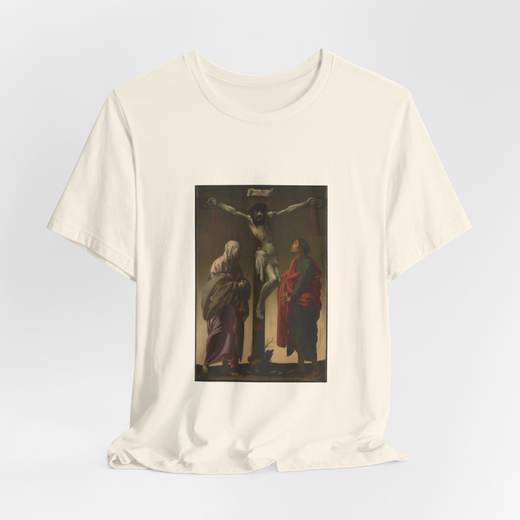
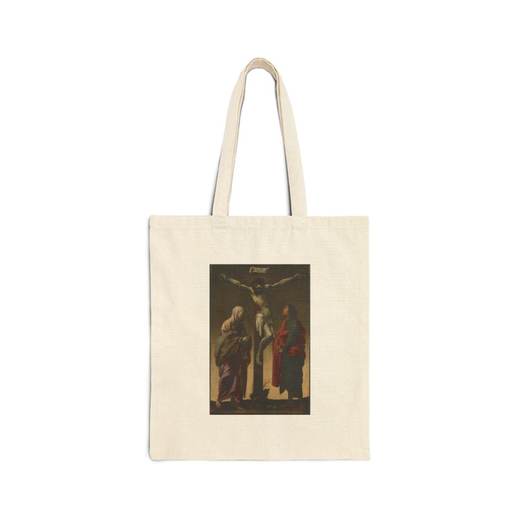
No Context Gallery independently uses the public-domain image. The source museum has not endorsed, sponsored, or affiliated itself with these products.
Research sources
See the products currently available with this artwork. Product choices appear only when the exact item is published, in stock, and available to purchase.