Artwork story
About Ten Kings of Hell
The artist and artwork
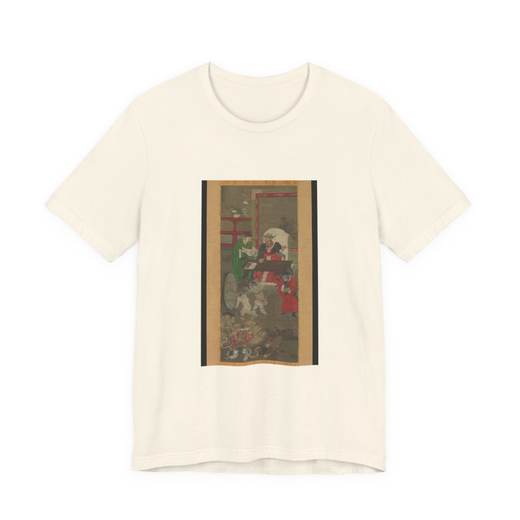
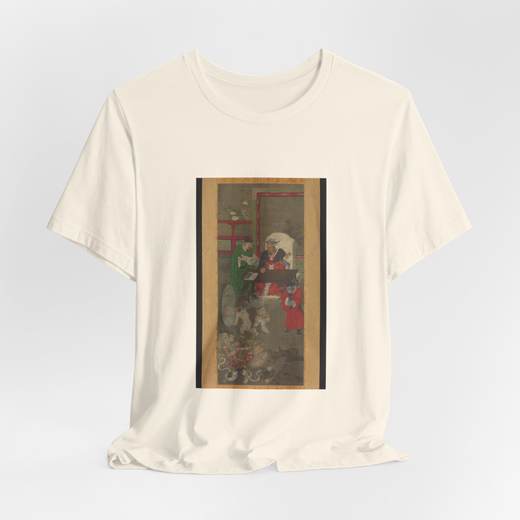
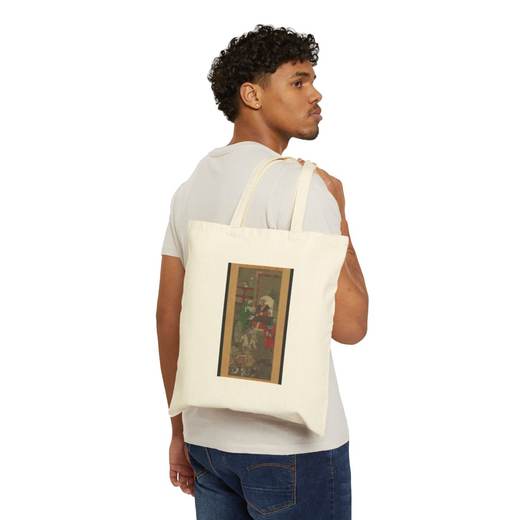
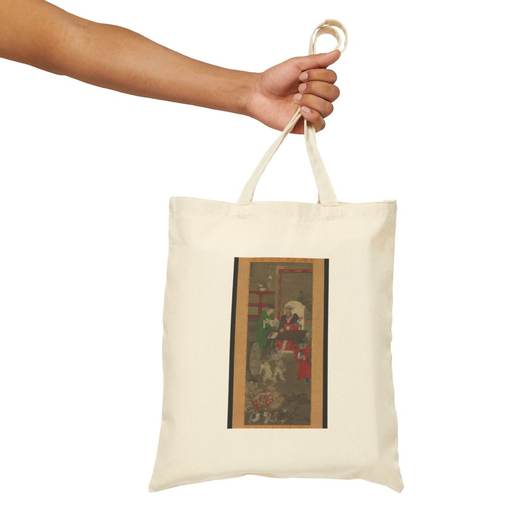
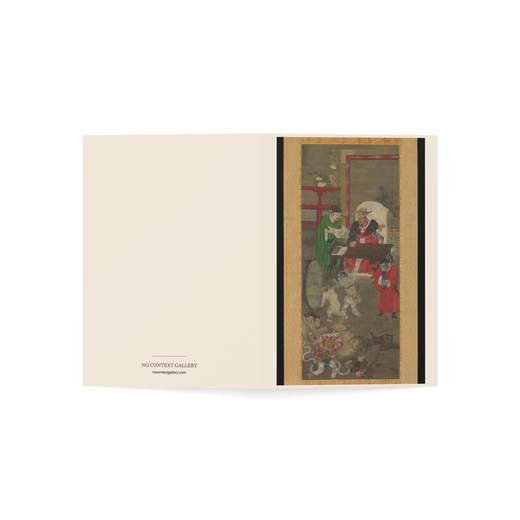
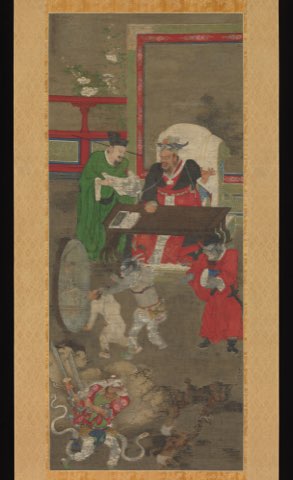
Ten Kings of Hell was made before 1195 in the studio of Jin Chushi, a Buddhist layman active in Mingzhou, the city now called Ningbo. The long hanging scroll is painted in ink and color on silk and belongs to a cycle that originally required ten images. A king sits behind a table as a green-robed official presents a document; below, animal-headed demons seize and punish souls.
The world around it
The subject developed in China during the later Tang dynasty by transforming Indian Buddhist judgment after death into a bureaucratic sequence familiar from earthly government. A soul faced a different king weekly for seven weeks, then the eighth judge on the hundredth day, the ninth after one year, and the tenth after three years before rebirth. This scroll was produced under the Southern Song, when Ningbo was an important port for Japanese merchants and Buddhist pilgrims. The workshop's inscription still uses the name Mingzhou; because the city became Qingyuanfu in 1195, that administrative change supplies the latest possible date.
A detail to notice
The painting makes the afterlife look disturbingly procedural. At the top, the judge raises one hand while his clerk unrolls a written record across the desk: punishment begins with paperwork. Below that calm office, the composition breaks into episodes. A horned demon restrains a nearly naked soul, another red-robed creature grips someone against its body, and a muscular guardian raises an enormous sword beside a curling snake and pale bird. The set's structure extends that logic beyond one scroll, judgment is neither a single verdict nor an endless blur, but a timed chain of hearings. Five related scrolls are now grouped under The Met's accession numbers 30.76.290 through .294, allowing viewers to reconstruct part of the larger narrative sequence.
Look closer: materials, scale, and subjects
The recorded object is hanging scroll made in One of five of a set of ten hanging scrolls; ink and color on silk and held in the Asian Art department.
Recorded dimensions include Image: 51 x 19 1/2 in. (129.5 x 49.5 cm); Overall with knobs: 80 x 27 1/2 in. (203.2 x 69.9 cm).
Subject terms include Swords, Kings, Men, Snakes, and Demons. Treat them as guideposts, not a complete interpretation.
Collection history and public-domain source
The collection credit line is Rogers Fund, 1930.
The individual artwork page and official image were verified as Public Domain on 2026-08-23.
No Context Gallery independently uses the public-domain image. The source museum has not endorsed, sponsored, or affiliated itself with these products.
Research sources
See the products currently available with this artwork. Product choices appear only when the exact item is published, in stock, and available to purchase.