Artwork story
About Silk Animal Carpet
The artist and artwork
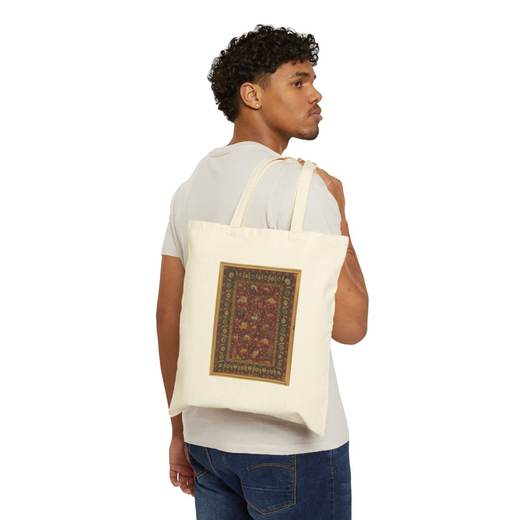
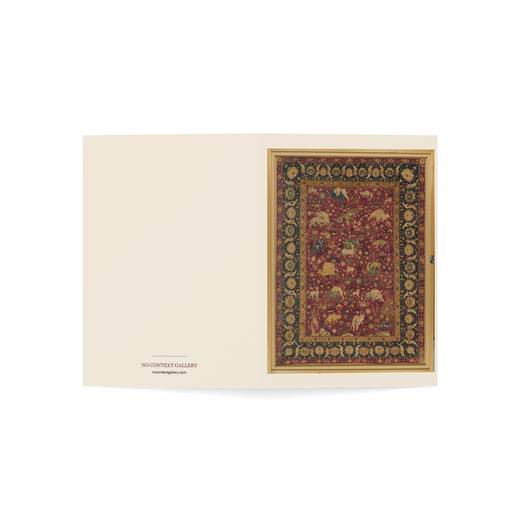
An unknown Iranian designer and team of weavers made the Silk Animal Carpet in the second half of the sixteenth century, probably in Kashan. Silk forms its warp, weft, and dense pile; asymmetrically tied knots create the pattern. Approximately eight hundred knots occupy each square inch. That fineness lets the red field behave like a painting, carrying tiny blossoms, leaves, birds, and animals in combat.
The world around it
The carpet belongs to Safavid Iran, a dynasty that united the country and made Shi'a Islam the state religion. Under Shah Tahmasp, royal studios joined painters from different traditions; textiles and carpets translated manuscript illumination and bookbinding into luxury furnishings. Iran's silk economy linked farms, workshops, carpet centers, the court, and international trade. Kashan is associated with these all-silk carpets, although the Met cautions that the geographic name is not completely certain. Shared imagery points to painters, designers, and weavers using related visual sources.
A detail to notice
There is no central medallion or single scene. The eye wanders through a crimson garden where encounters repeat without becoming identical. Pale lions attack darker prey; tigers, rams, deer, and spotted dragons turn in opposing directions; horned deerlike creatures derived from Chinese art move among Persian flowers. The dark-green border replaces combat with stately birds facing enormous blossoms. The Met calls the treatment painterly and finds comparable animals in contemporary manuscripts and lacquer bookbindings. Knotted silk feels drawn because each minute color change works like a brushstroke. Wear softens some creatures almost into ghosts, but their movement remains readable. This functional surface is also a display of technical command, an imagined ecosystem built one tiny knot at a time.
Look closer: materials, scale, and subjects
The recorded object is carpet made in Silk (warp, weft, and pile); asymmetrically knotted pile and held in the Islamic Art department.
Recorded dimensions include Rug: L. 94 7/8 in. (241 cm); W. 70 1/16 in. (178 cm); Mount: L. 103 1/4 in. (262.3 cm); W. 78 in. (198.1 cm); D. 3 in. (7.6 cm); Wt. 206 lbs. (93.4 kg).
Subject terms include Animals, Birds, Dragons, Deer, Lions, and Rams. Treat them as guideposts, not a complete interpretation.
Collection history and public-domain source
The collection credit line is Bequest of Benjamin Altman, 1913.
The individual artwork page and official image were verified as Public Domain on 2026-08-23.
No Context Gallery independently uses the public-domain image. The source museum has not endorsed, sponsored, or affiliated itself with these products.
Research sources
See the products currently available with this artwork. Product choices appear only when the exact item is published, in stock, and available to purchase.