Artwork story
About Fish Market
The artist and artwork
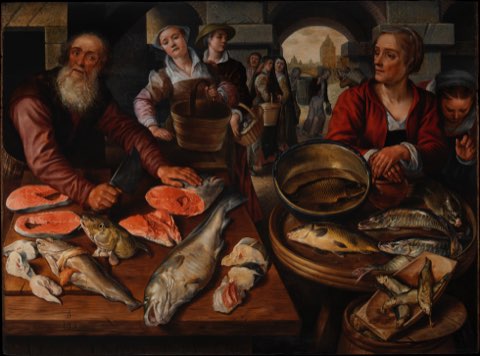
Joachim Beuckelaer painted Fish Market in Antwerp in 1568. The large oil painting on Baltic oak turns a food stall into a theater of color, texture, and human attention. Beuckelaer learned from his uncle Pieter Aertsen; together they helped establish market scenes in which everyday goods commanded the scale and care of grand subjects. Salmon steaks, cod, carp, pike, and herring crowd the foreground while sellers and shoppers negotiate around them. This is both an image of daily life and an early step toward still life as a subject in its own right.
The world around it
The painting was made in the Spanish Netherlands during religious and political upheaval. In 1566, iconoclasm damaged or destroyed religious images across the region. The Met connects that disruption to growing demand for secular subjects, including markets and kitchens. Antwerp's urban commerce made the goods of daily life worth close attention: a fish stall could display abundance, labor, appetite, and trade at once. Later Dutch and Flemish painters developed still life as an independent genre, but Beuckelaer kept social exchanges inside the frame. This abundance may also warn against excessive pleasure rather than simply celebrate the catch.
A detail to notice
Look closely at the fish. Beuckelaer used thick paint and scratched passages to suggest slippery scales and flesh, especially on the pike. Then look behind the display. A fishmonger poised to cut another piece of salmon glances at a woman beside the stall. She crosses her hands over an open vessel in a gesture The Met reads as a possible rebuff to his attention. Other shoppers continue talking, apparently missing the exchange. The viewer becomes a witness to a passing social moment, not just an inventory of seafood. The fish command attention first; the conversation among the people comes into focus later.
Look closer: materials, scale, and subjects
The recorded object is painting made in Oil on Baltic oak and held in the European Paintings department.
Recorded dimensions include 50 5/8 × 68 7/8 in. (128.6 × 174.9 cm).
Subject terms include Food, Men, Women, Fish, and Markets. Treat them as guideposts, not a complete interpretation.
Collection history and public-domain source
The collection credit line is Purchase, Lila Acheson Wallace Gift and Bequest of George Blumenthal, by exchange, 2015.
The individual artwork page and official image were verified as Public Domain on 2026-08-24.
No Context Gallery independently uses the public-domain image. The source museum has not endorsed, sponsored, or affiliated itself with these products.
Research sources
See the products currently available with this artwork. Product choices appear only when the exact item is published, in stock, and available to purchase.


