Artwork story
About The Ameya
The artist and artwork
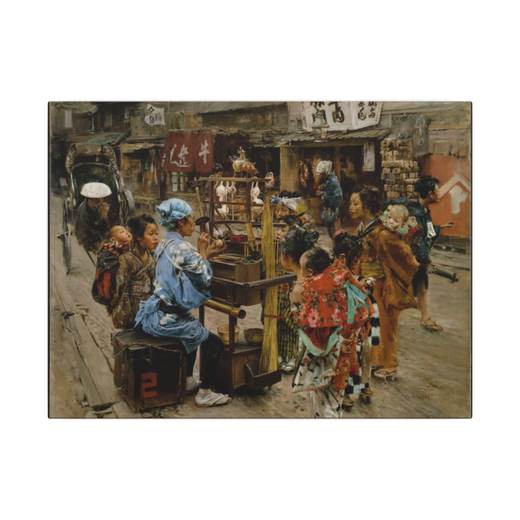
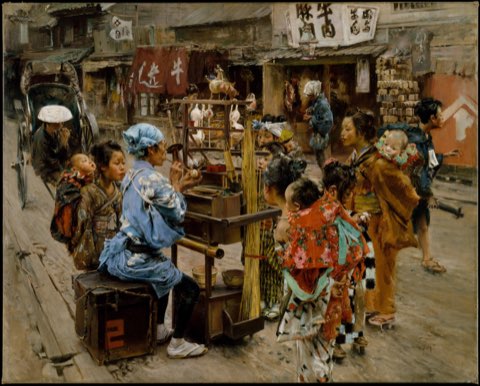
American artist and illustrator Robert Frederick Blum painted The Ameya by 1893 after traveling to Japan in 1890 for Scribner's Magazine. He spent eighteen months there producing illustrations for articles that appeared in 1893; a published image titled The Ameya became the basis for this oil on canvas. An ameya was a candy blower who shaped candy much as a glassblower shaped molten glass. Blum admired the results as artistic though temporary, making skilled work, rather than a landmark, the painting's subject.
The world around it
Blum worked during Japan's Meiji period, when the country was modernizing through increased engagement with the West. Japanese prints and decorative arts had also transformed European and American taste after Japan's ports reopened to Western trade in the 1850s. By the 1890s, Japonisme encouraged Western artists to value asymmetry, unusual viewpoints, and everyday subjects. The Ameya participated in that exchange but also carried a specific American publishing purpose: Blum's observed street scene reached readers through an illustrated magazine before becoming a painting.
A detail to notice
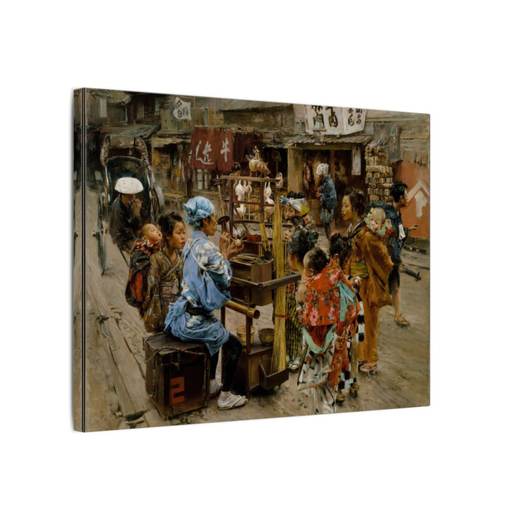
The candy maker in blue sits left of center, blowing or shaping an object while customers lean inward. The wooden stall creates a barrier, yet nearly every face crosses it through attention. Women carry two babies on their backs; the adults watch the craft, while both infants turn outward toward us. A rickshaw enters from the shadowed left, another passerby is cropped at the far right, and shop signs crowd the upper edge, so the gathering feels embedded in a moving street. Vertical sticks at the stall echo posts, signs, and stacked wares behind them. Bright blue, orange, red, and patterned clothing pull the foreground figures together against weathered browns. The spectacle is small, but Blum makes looking itself the event: the vendor holds the crowd, the crowd frames the craft, and the babies quietly return the viewer's gaze.
Look closer: materials, scale, and subjects
The recorded object is painting made in Oil on canvas and held in The American Wing.
Recorded dimensions include 25 1/16 x 31 1/16 in. (63.7 x 78.9 cm).
Subject terms include Infants, Women, Street Scene, and Working. Treat them as guideposts, not a complete interpretation.
Collection history and public-domain source
The collection credit line is Gift of Estate of Alfred Corning Clark, 1904.
The individual artwork page and official image were verified as Public Domain on 2026-08-23.
No Context Gallery independently uses the public-domain image. The source museum has not endorsed, sponsored, or affiliated itself with these products.
Research sources
See the products currently available with this artwork. Product choices appear only when the exact item is published, in stock, and available to purchase.