Artwork story
About The Titan's Goblet
The artist and artwork
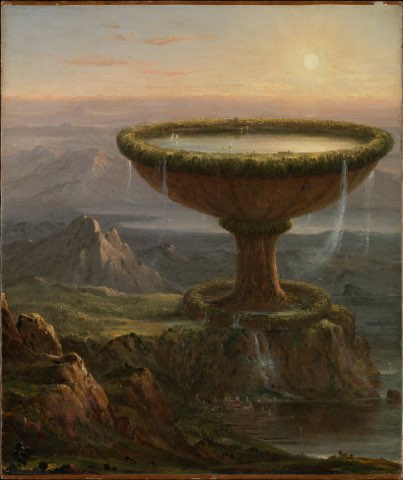
Thomas Cole painted The Titan’s Goblet in 1833, the year after returning from his first European tour. The English-born American artist had transformed landscape painting in the United States by treating scenery as a vehicle for history, literature, religion, and moral thought. This oil on canvas is not a view of an actual place. An immense stone cup rises from an earthly valley, carrying water, forests, ruins, settlements, and tiny boats high above the surrounding mountains.
The world around it
Cole had spent 1829–32 in Europe, where Italy’s landscape, ancient ruins, and classical past left a lasting mark. Back in New York, patron Luman Reed encouraged the ambitious historical landscapes that became The Course of Empire, begun in 1833. The young United States was also changing under Andrew Jackson through expansion with severe ecological and social consequences. Cole’s mature work repeatedly asked what happens when civilizations rise, transform nature, and pass away. Here that question becomes a world balanced on a weathered object.
A detail to notice
The painting resists a single explanation. Scholars and former owners have connected its goblet to Norse legend, Greek myth, Italian geology and architecture, Turner, and the sun god Helios; The Met describes the work as ultimately enigmatic. Look closely at the cup instead of only at its silhouette. Boats cross its glassy lake, buildings and classical ruins ring the wooded lip, and streams spill over as waterfalls. Far below, another settlement occupies the ordinary valley. The two inhabited levels make the goblet seem at once a vessel, a monument, and a self-contained civilization being reclaimed by vegetation and time.
Look closer: materials, scale, and subjects
The recorded object is painting made in Oil on canvas and held in The American Wing.
Recorded dimensions include 19 3/8 x 16 1/8 in. (49.2 x 41 cm).
Subject terms include Fountains, Sun, Hills, and Landscapes. Treat them as guideposts, not a complete interpretation.
Collection history and public-domain source
The collection credit line is Gift of Samuel P. Avery Jr., 1904.
The individual artwork page and official image were verified as Public Domain on 2026-08-23.
No Context Gallery independently uses the public-domain image. The source museum has not endorsed, sponsored, or affiliated itself with these products.
Research sources
See the products currently available with this artwork. Product choices appear only when the exact item is published, in stock, and available to purchase.