Artwork story
About Plums
The artist and artwork
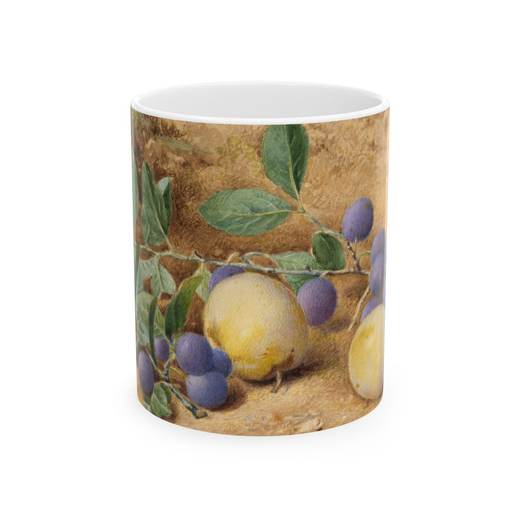
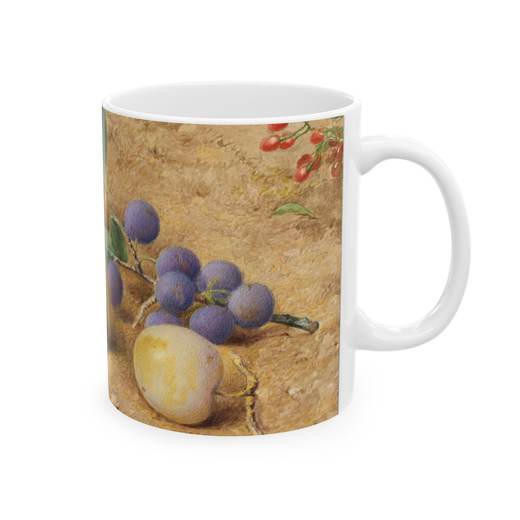
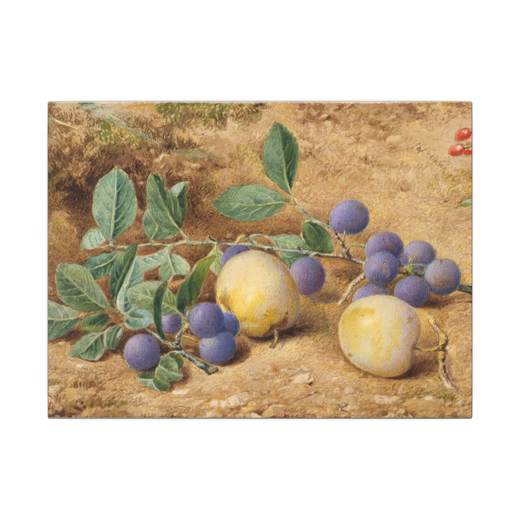
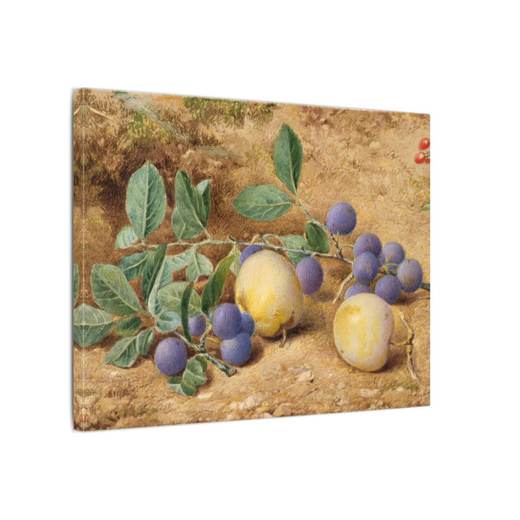
John William Hill painted Plums in 1870 with watercolor, graphite, and opaque gouache on off-white Bristol board. Born in London and brought to the United States as a child, Hill first learned precise topographical watercolor from his engraver father. By the late 1850s he had embraced the ideas of British critic John Ruskin and the Pre-Raphaelites. Instead of arranging fruit on a polished table, he placed cut branches, dark blue plums, two pale yellow plums, and a distant spray of red berries directly against rough earth.
The world around it
Hill made the sheet while the United States was in Reconstruction, five years after the Civil War. In 1870 the Fifteenth Amendment prohibited denying a citizen the vote because of race, even as the struggle over equal citizenship remained violent and unfinished. American art was also changing. Watercolor had long served instruction, portrait miniatures, and designs for prints, but artists were claiming it as a finished medium. The American Society of Painters in Water Colors had been founded in 1866. Hill and other Ruskinian artists made minute observation of ordinary nature feel both modern and morally serious.
A detail to notice
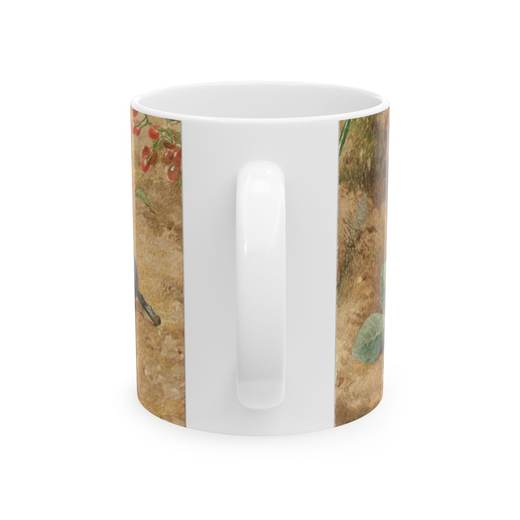
The picture's most remarkable effect comes from marks that nearly disappear into what they describe. Hill built the fruit, leaves, bark, and soil from countless small touches of pure color, adding gouache where he wanted opacity. Look at the two kinds of plums: velvety blue skins are modeled with violet, red, and pale bloom, while the yellow fruit carries thin warm strokes that suggest its fuzzy surface. Leaf veins stay crisp, broken twigs project toward us, and the red berries at upper right are cropped as if the study continues beyond the paper. Hill signed and dated the lower left, making patient observation the true subject.
Look closer: materials, scale, and subjects
The recorded object is watercolor made in Watercolor, graphite, and gouache on off-white Bristol board and held in The American Wing.
Recorded dimensions include 7 1/8 x 12 in. (18.1 x 30.5 cm).
Subject terms include Fruit and Still Life. Treat them as guideposts, not a complete interpretation.
Collection history and public-domain source
The collection credit line is Gift of J. Henry Hill, 1882.
The individual artwork page and official image were verified as Public Domain on 2026-08-23.
No Context Gallery independently uses the public-domain image. The source museum has not endorsed, sponsored, or affiliated itself with these products.
Research sources
See the products currently available with this artwork. Product choices appear only when the exact item is published, in stock, and available to purchase.