Artwork story
About Spring Blossoms, Montclair, New Jersey
The artist and artwork
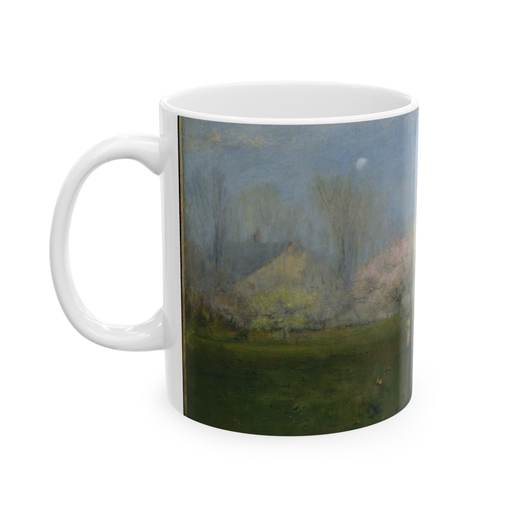
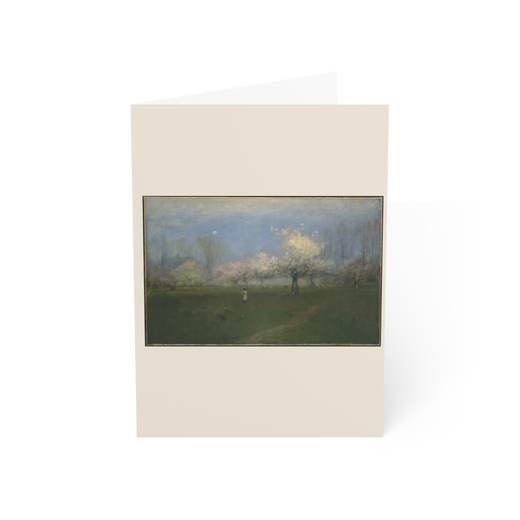
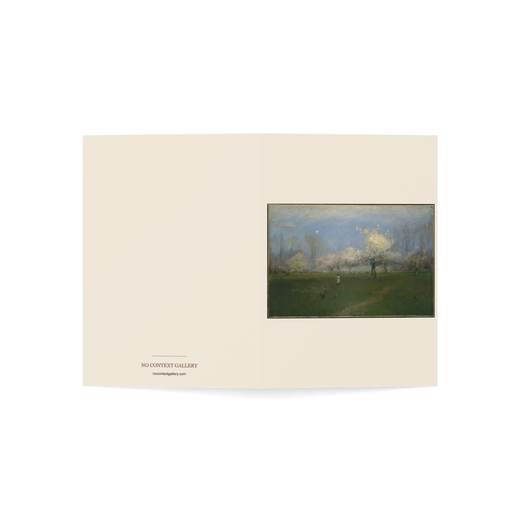
George Inness painted Spring Blossoms, Montclair, New Jersey around 1891 in the artist colony he established there. Working with oil and crayon or charcoal on canvas, he dissolved the exact contours favored by earlier Hudson River School painters into veils of blue, gray, green, pink, and white. French Barbizon painting helped him move toward intimate, atmospheric landscape, while the writings of Swedish scientist and theologian Emanuel Swedenborg encouraged him to treat visible nature as a doorway to spiritual meaning. By the 1880s, younger European-trained painters admired him as an “American Original.”
The world around it
Inness made the picture during the Gilded Age, when the United States was becoming an industrial and urban power and its professional art world was expanding rapidly. Many artists answered industrial change by returning to rural or suburban scenery, but Inness did not offer a precise survey of Montclair. He had settled permanently on his New Jersey estate in 1885 and used familiar fields, trees, weather, and light as material for contemplation. His famous principle was that art should suggest reality because it could never simply reproduce it.
A detail to notice
The painting announces spring without a bright noon sky. It is dusk: a pale moon hangs left of center, bare trunks recede into blue haze, and only a few trees carry blossoms. A large dark trunk anchors the right half, where white flowers seem to catch and hold the last light; a smaller pink tree answers it across the field. Near the center, a tiny standing figure in a light dress and dark hat is almost absorbed by the grass, while an even smaller animal appears closer to the foreground. The work's cracked surface and mixed drawn-and-painted marks remain visible. Rather than detailing each petal, Inness lets color and atmosphere make the blossoms flicker between solid matter, memory, and light.
Look closer: materials, scale, and subjects
The recorded object is painting made in Oil and crayon or charcoal on canvas and held in The American Wing.
Recorded dimensions include 29 x 45 1/4 in. (73.7 x 114.9 cm).
Subject terms include Landscapes, Trees, and Spring. Treat them as guideposts, not a complete interpretation.
Collection history and public-domain source
The collection credit line is Gift of George A. Hearn, in memory of Arthur Hoppock Hearn, 1911.
The individual artwork page and official image were verified as Public Domain on 2026-08-23.
No Context Gallery independently uses the public-domain image. The source museum has not endorsed, sponsored, or affiliated itself with these products.
Research sources
See the products currently available with this artwork. Product choices appear only when the exact item is published, in stock, and available to purchase.