Artwork story
About View on the Columbia, Cascades
The artist and artwork
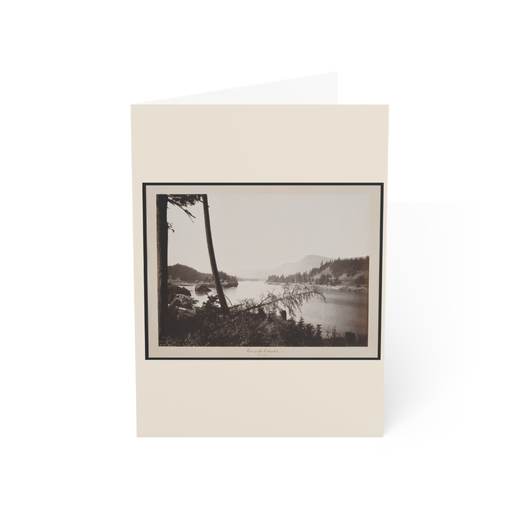
Carleton E. Watkins made View on the Columbia, Cascades in 1867 during a four-month photographic trip through Oregon and along the Columbia River. He used wet collodion to create a glass negative, then printed it on albumen-coated paper. With no practical enlargement, the negative had to be as large as the finished fifteen-by-twenty-inch image. Watkins carried a mammoth camera, fragile plates, chemicals, and a traveling darkroom, coating and developing each plate before its collodion dried. The photograph's calm precision was produced by strenuous work just beyond the frame.
The world around it
Watkins worked just after the Civil War, as railroads, mining, surveys, settlement, and commercial photography transformed the American West. The transcontinental railroad would be completed in 1869. His prints let distant viewers encounter western landscapes while helping land, tourism, industry, and conservation become public questions. Although nineteenth-century promotion often described such places as untouched wilderness, the Columbia was already an Indigenous homeland and a corridor of travel and trade. The photograph belongs to that expansionary age even as its stillness seems to suspend it.
A detail to notice
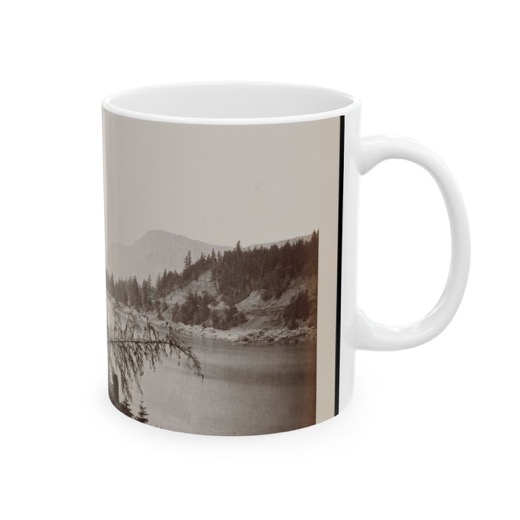
Two nearly black trunks form a gate at left, but a fallen conifer sweeping diagonally across the foreground is the disruptive shape. Its bare twigs veil the bright river, forcing the eye to look through damage before entering the distance. Smooth water narrows between dark islands and pale wooded slopes; a faint mountain almost dissolves into the enormous blank sky. Along the far-right bank, a thin constructed line cuts across the hillside, the quietest sign of human alteration. Watkins balances that intervention against vast light and water. The scene looks effortless, yet its foreground reminds us that every view has a position, an obstruction, and a history.
Look closer: materials, scale, and subjects
The recorded object is photograph made in Albumen silver print from glass negative and held in the Photographs department.
Recorded dimensions include 40.0 x 52.4 cm (15 3/4 x 20 5/8 in.).
Subject terms include Rivers and Landscapes. Treat them as guideposts, not a complete interpretation.
Collection history and public-domain source
The collection credit line is Warner Communications Inc. Purchase Fund and Harris Brisbane Dick Fund, 1979.
The individual artwork page and official image were verified as Public Domain on 2026-08-23.
No Context Gallery independently uses the public-domain image. The source museum has not endorsed, sponsored, or affiliated itself with these products.
Research sources
See the products currently available with this artwork. Product choices appear only when the exact item is published, in stock, and available to purchase.