Artwork story
About Christ Carrying the Cross
The artist and artwork
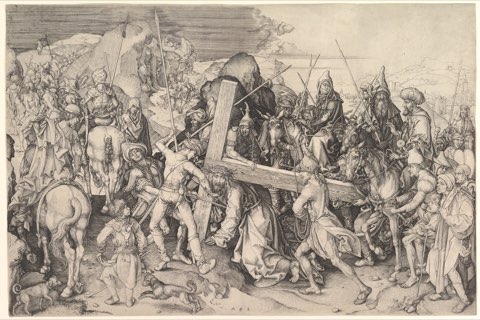
Martin Schongauer made Christ Carrying the Cross around 1475–80 as an engraving on a sheet about eleven by seventeen inches. A painter and printmaker from Colmar, he made this his largest and most painterly print by pressing Christ’s procession to Golgotha almost completely into the foreground. Horses, soldiers, onlookers, dogs, weapons, and the cross crowd the horizontal plate. The movement is dense, but Christ’s face remains the still point inside it.
The world around it
This work belongs to the first generations in which European engraving became a portable, repeatable art. Schongauer came from a family involved in goldsmithing, although The Met cautions that the extent of his own training in that craft is unclear. His engraved images circulated beyond Colmar as models that other makers could study and copy. The transportable medium made his balanced compositions influential in the fifteenth and sixteenth centuries; Albrecht Dürer admired them enough to travel to Colmar in 1492, only to arrive after Schongauer’s death.
A detail to notice
The Met calls this Schongauer’s most visually complex engraving. He built a spectrum from white through gray to black simply by changing the density of his hatching. Fully shaded figures at the right stand against an outline-only landscape, while the boy at lower left reverses that light-and-dark arrangement. The composition was inspired by a now-lost Jan van Eyck painting known through copies, but Schongauer pushed the action forward. Then he made one figure escape the crowd: Christ turns his head and looks directly outward, confronting the viewer from within the procession.
Look closer: materials, scale, and subjects
The recorded object is print made in Engraving and held in the Drawings and Prints department.
Recorded dimensions include Sheet: 11 3/8 × 16 7/8 in. (28.9 × 42.9 cm).
Subject terms include Soldiers, Dogs, Horses, Christ, Cross, and Bearing the Cross. Treat them as guideposts, not a complete interpretation.
Collection history and public-domain source
The collection credit line is Purchase, The Sylmaris Collection, Gift of George Coe Graves, by exchange, 1935.
The individual artwork page and official image were verified as Public Domain on 2026-08-23.
No Context Gallery independently uses the public-domain image. The source museum has not endorsed, sponsored, or affiliated itself with these products.
Research sources
See the products currently available with this artwork. Product choices appear only when the exact item is published, in stock, and available to purchase.


