Artwork story
About Nocturne (Nocturne: The Thames at Battersea)
The artist and artwork
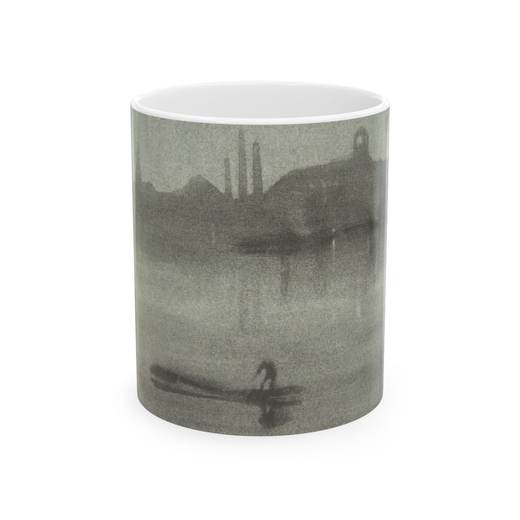
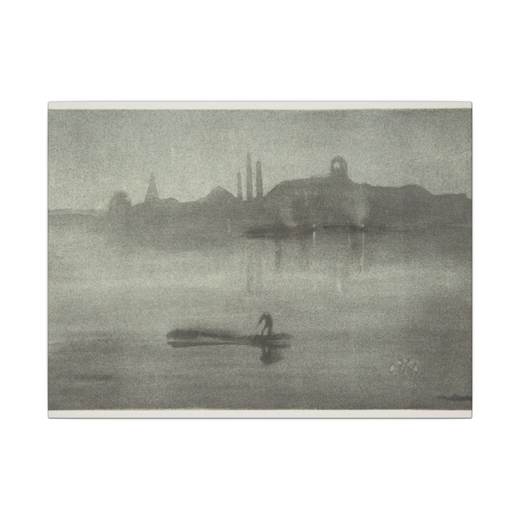
James McNeill Whistler made Nocturne: The Thames at Battersea in 1878 as a lithotint, working directly on a prepared stone with ink washes and scraping into a half-tint ground. Soft gray-black ink sits on pale-blue laid paper mounted to an ivory support; this is the second and final state. The American-born artist studied in Paris and settled in London, treating printmaking as seriously as painting. His musical title, Nocturne, asks us to experience a harmony of tone rather than demand a detailed report of each building and boat.
The world around it
Victorian London's Thames was an industrial artery of wharves and warehouses and the river beside Whistler's Chelsea home. Reducing that landscape to silhouettes, he joined modern urban subject matter to the Aesthetic movement's belief in visual effect. Japanese prints informed his flat spaces, asymmetry, and cropping, while musical titles resisted literal storytelling. This print appeared when Whistler's libel suit against critic John Ruskin was heard. Ruskin had attacked a painted Nocturne; Whistler won in 1878, but court costs helped force his bankruptcy the following year.
A detail to notice
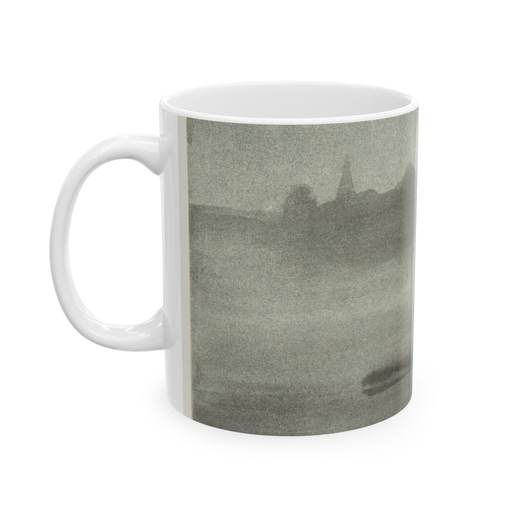
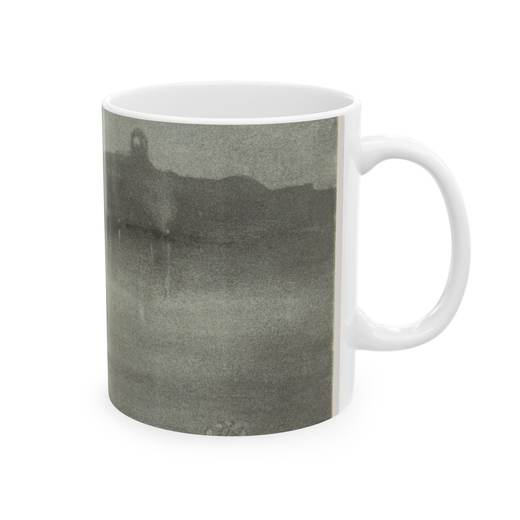
Almost everything solid is disappearing. A lone figure bends in a narrow boat below center, and the reflection doubles the body into one vertical mark. Across the river, low roofs, two chimneys, a larger block, and rounded tower become a gray band between water and sky. Scraped lights interrupt the surface like mist. Whistler's butterfly monogram rests at lower right as part of the design. The human action emerges only after prolonged looking; water and air dominate substance, so an industrial shoreline feels less like machinery than a memory forming at dusk.
Look closer: materials, scale, and subjects
The recorded object is print made in Lithotint with scraping on a prepared half-tint ground, printed in soft gray-black ink on pale blue laid chine mounted on ivory wove plate paper; second state of two (Chicago) and held in the Drawings and Prints department.
Recorded dimensions include Image: 6 3/4 × 10 3/16 in. (17.1 × 25.9 cm); Sheet: 13 1/2 × 19 5/16 in. (34.3 × 49 cm).
Subject terms include Rivers and Boats. Treat them as guideposts, not a complete interpretation.
Collection history and public-domain source
The collection credit line is Harris Brisbane Dick Fund, 1917.
The individual artwork page and official image were verified as Public Domain on 2026-08-23.
No Context Gallery independently uses the public-domain image. The source museum has not endorsed, sponsored, or affiliated itself with these products.
Research sources
See the products currently available with this artwork. Product choices appear only when the exact item is published, in stock, and available to purchase.