Artwork story
About Vanitas Still Life
The artist and artwork
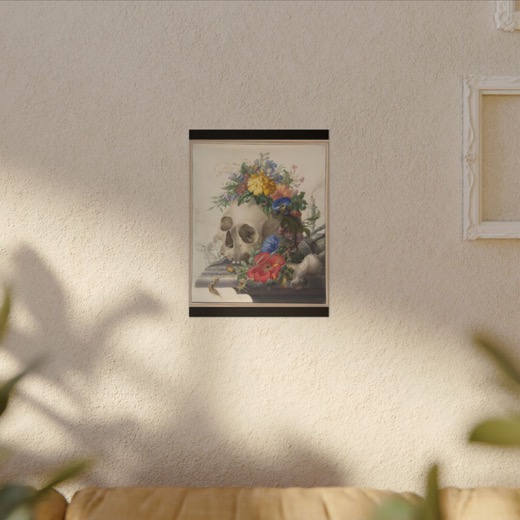
Herman Henstenburgh made this Vanitas Still Life in watercolor, gouache, and gum arabic on parchment. A pastry chef who painted in his free time, he became a master of precise watercolor still life around 1700. He layered transparent and opaque color on fine parchment, using gum arabic to heighten the glow of flowers, leaves, bone, glass, paper, and insect wings.
The world around it
The current object page leaves the date unspecified, while The Met's 2003 acquisition bulletin placed the sheet around 1700. It belongs to a late Dutch Golden Age culture in which still lifes joined observation, collecting, commerce, and moral reflection. Dutch and foreign buyers sought Henstenburgh's drawings; by 1700, Cosimo III de' Medici owned three. Their technical luxury carried a warning: a vanitas, or memento mori, asked viewers to remember that beauty, pleasure, possessions, music, and life must pass.
A detail to notice
Henstenburgh makes that warning seductive. A garland of yellow, red, blue, violet, and pink flowers spills across two skulls and a long bone. Butterflies hover, a snail crosses the leaves, wheat droops, and moisture shines on the red bloom. Behind them, smoke curls from a just-extinguished candle and an hourglass lies on its side. The Met identifies skull, bone, candle, hourglass, and flowers as signs of life's fragility and brevity. A crumpled sheet of music adds another vanishing thing: sound. Its inscription reads `Blyschap van my ex`, translated cautiously by The Met as “Joy is leaving me [?].” Gum arabic makes the colors luminous, while the objects declare that color, scent, music, and the body cannot last. Even the exact date has faded, but Henstenburgh's minute technique keeps the warning alive.
Look closer: materials, scale, and subjects
The recorded object is drawing made in Watercolor, gouache, and gum arabic on parchment and held in the Drawings and Prints department.
Recorded dimensions include sheet: 13 x 11 in. (33 x 27.9 cm).
Subject terms include Skulls, Flowers, Still Life, and Hourglass. Treat them as guideposts, not a complete interpretation.
Collection history and public-domain source
The collection credit line is Purchase, Anonymous Gift, in memory of Frits Markus, and Frits and Rita Markus Fund, 2003.
The individual artwork page and official image were verified as Public Domain on 2026-08-24.
No Context Gallery independently uses the public-domain image. The source museum has not endorsed, sponsored, or affiliated itself with these products.
Research sources
See the products currently available with this artwork. Product choices appear only when the exact item is published, in stock, and available to purchase.