Artwork story
About Knight, Death and the Devil
The artist and artwork
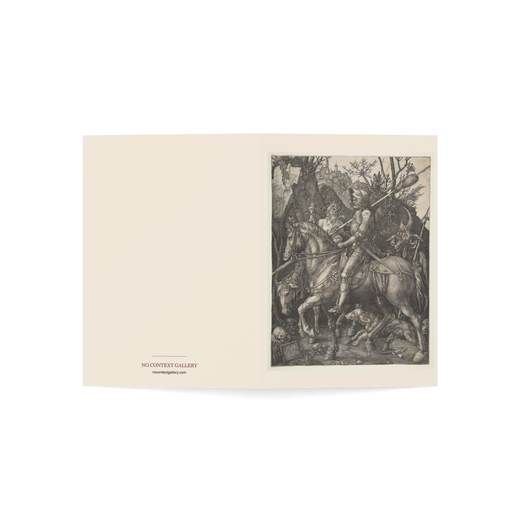
Albrecht Dürer made Knight, Death and the Devil in 1513 as an engraving: a copper plate cut with a burin so that ink in its grooves could print controlled lines. Trained first in his goldsmith father's workshop, he used swelling and crossing strokes to turn black ink into polished armor, horsehide, hair, rock, and dim air. Dürer called the print simply the Rider. It became one of three celebrated 1513–14 Meisterstiche, or master engravings, alongside Melencolia I and Saint Jerome in His Study, related achievements, though not a narrative trilogy.
The world around it
Nuremberg was a major commercial and artistic center of the Northern Renaissance, and repeatable prints let Dürer's inventions travel farther than a single painting. His two journeys to Italy exposed him to classical theory, proportion, and the tradition of heroic equestrian portraits, which he joined to a dense northern gorge. The master engravings were aimed more at connoisseurs and collectors than at popular devotion. This sheet appeared four years before Martin Luther's 1517 theses, in a Christian humanist world already debating personal discipline and reform. Its steadfast rider may draw on Erasmus's 1504 Handbook of the Christian Soldier, but that literary connection remains a scholarly proposal rather than a documented commission.
A detail to notice
The knight never turns toward either threat. Death rides beside him on a bony horse and raises an hourglass; behind, a pig-snouted, horned Devil crowds the path with a halberd. The rider's spear and horse drive forward almost horizontally while the gorge and dead branches knot around them. A dog keeps pace below, a lizard crosses the road, and skulls lie beside Dürer's dated monogram plaque. Far above, a fortress suggests a destination, but the route remains steep and obscure. The hourglass makes time visible, yet the knight's fixed gaze converts the supernatural encounter into moral resolve, the active life continuing without looking back.
Look closer: materials, scale, and subjects
The recorded object is print made in Engraving and held in the Drawings and Prints department.
Recorded dimensions include sheet: 9 1/2 x 7 3/8 in. (24.2 x 18.8 cm).
Subject terms include Swords, Men, and Horses. Treat them as guideposts, not a complete interpretation.
Collection history and public-domain source
The collection credit line is Bequest of Scofield Thayer, 1982.
The individual artwork page and official image were verified as Public Domain on 2026-08-23.
No Context Gallery independently uses the public-domain image. The source museum has not endorsed, sponsored, or affiliated itself with these products.
Research sources
See the products currently available with this artwork. Product choices appear only when the exact item is published, in stock, and available to purchase.