Artwork story
About 'Aqua' in a Decorative Border with Sea Creatures, from a Series of Circular Designs with the Four Elements
The artist and artwork
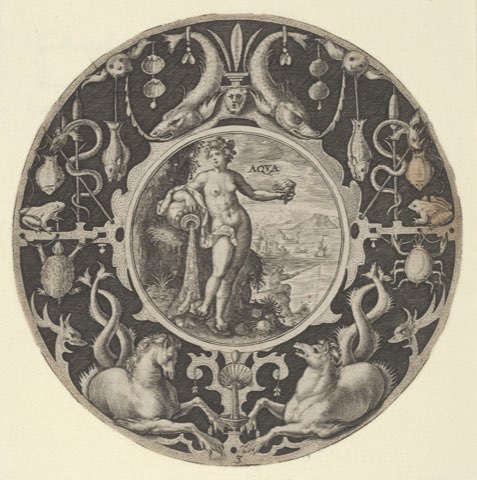
Crispijn de Passe the Elder made Aqua between 1590 and 1612 as an engraving and design for a circular plate. The Netherlandish printmaker turns Water into a standing female personification inside a central medallion. She holds a shell and leans against an overturned vessel that releases a stream. Dense hatching creates flesh, sky, water, and the surrounding black field on a sheet only about five inches across.
The world around it
The print appeared while the Eighty Years' War divided the Netherlands and print publishing was becoming an international business. Engravings could travel more easily than paintings or metalwork, carrying images among artists, collectors, publishers, and workshops. Renaissance ornament prints frequently served as patterns or inspiration for artisans making vessels, jewelry, furniture, and other objects for a growing merchant market. Aqua belongs to that practical world of circulating design as well as to the learned Renaissance habit of personifying nature through figures drawn from classical mythology.
A detail to notice
This is plate 3 of a four-print series devoted to the elements, but Water occupies several visual worlds at once. Inside the medallion, the word AQUA floats beside the figure; a coastal town, sailboats, and a person fishing turn allegory into everyday labor. Fish spill from the vessel with the water. Outside, the orderly scene becomes an inventory of marine strangeness: paired fish-tailed horses flank a small fountain, dolphins curve over the top, and fish, frogs, turtles, rays, crustaceans, and serpentine creatures hang against the dark ground like specimens. The circular frame makes the border look suitable for metalwork while also trapping a whole sea around the central figure. De Passe's engraved sheet survives as the design; the Met does not identify a completed plate made from it. Its fascination lies in that suspended possibility, a compact print that is simultaneously allegory, pattern, coastal landscape, and cabinet of aquatic curiosities.
Look closer: materials, scale, and subjects
The recorded object is print ornament & architecture made in Engraving and held in the Drawings and Prints department.
Recorded dimensions include Sheet: 5 × 4 3/4 in. (12.7 × 12.1 cm).
Subject terms include Animals, Medallions, Female Nudes, and Fishing. Treat them as guideposts, not a complete interpretation.
Collection history and public-domain source
The collection credit line is Harris Brisbane Dick Fund, 1917.
The individual artwork page and official image were verified as Public Domain on 2026-08-23.
No Context Gallery independently uses the public-domain image. The source museum has not endorsed, sponsored, or affiliated itself with these products.
Research sources
See the products currently available with this artwork. Product choices appear only when the exact item is published, in stock, and available to purchase.


