Artwork story
About The Horse Fair
The artist and artwork
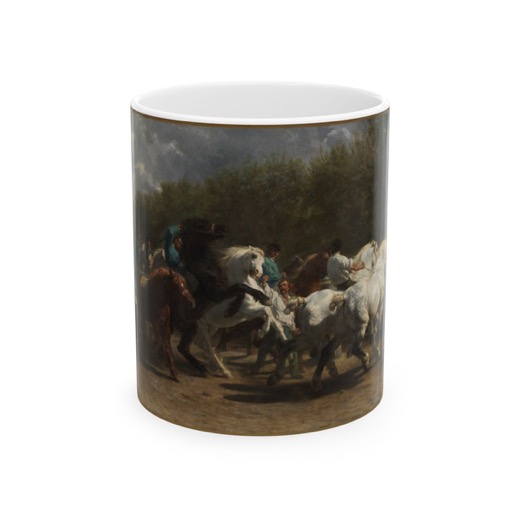
Rosa Bonheur painted The Horse Fair in 1852–55 as a monumental oil-on-canvas panorama more than sixteen feet wide. Trained by her father Raimond, a drawing teacher and landscape painter, Bonheur built her career by specializing in animals. She was acclaimed when she began this scene of handlers driving horses around the Paris market on the Boulevard de l'Hôpital. For a year and a half she visited twice each week to draw movement and anatomy from life.
The world around it
Bonheur began the painting only a few years after the Revolution of 1848 overthrew Louis-Philippe, and she exhibited it during Napoleon III's new Second Empire. French Realism was turning from idealized history toward direct observation of modern life, but professional women still faced severe restrictions: the École des Beaux-Arts did not admit women until 1897, and access to life drawing and public study was limited. Bonheur obtained official permission to wear trousers and used men's clothing at horse fairs, stockyards, and slaughterhouses so she could study without attracting attention. Shown at the Salon of 1853, her huge subject won wide praise and made her internationally successful.
A detail to notice
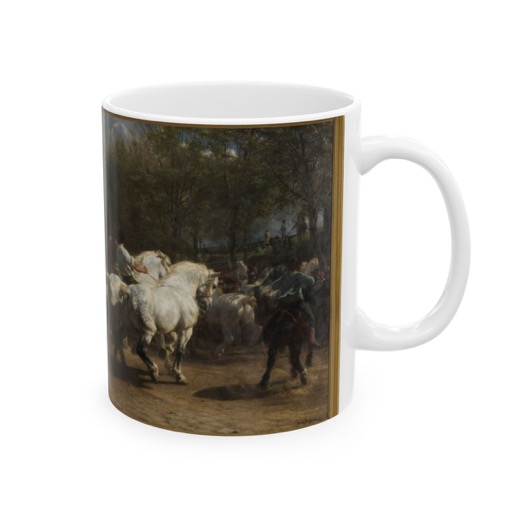
The painting combines field observation with the grandeur of ancient sculpture. Bonheur studied horses scientifically, yet also drew on George Stubbs, Théodore Géricault, Eugène Delacroix, and the Parthenon's carved horses; she called the work her own ‘Parthenon frieze.’ The animals surge in a broad circle, some controlled by mounted riders and others straining against handlers on foot, while buyers watch from a grassy bank. The Salpêtrière in the left distance anchors the commotion in Paris. Bonheur revised the canvas in 1855 and added a 5 to its earlier date. One critic reportedly felt compelled to jump aside, as if the horses might break through the picture. That illusion comes from a deliberate contradiction: exact legs, muscles, tack, and gestures are orchestrated with the ceremonial rhythm of a classical procession.
Look closer: materials, scale, and subjects
The recorded object is painting made in Oil on canvas and held in the European Paintings department.
Recorded dimensions include 96 1/4 x 199 1/2 in. (244.5 x 506.7 cm).
Subject terms include Men, Horses, and Paris. Treat them as guideposts, not a complete interpretation.
Collection history and public-domain source
The collection credit line is Gift of Cornelius Vanderbilt, 1887.
The individual artwork page and official image were verified as Public Domain on 2026-08-24.
No Context Gallery independently uses the public-domain image. The source museum has not endorsed, sponsored, or affiliated itself with these products.
Research sources
See the products currently available with this artwork. Product choices appear only when the exact item is published, in stock, and available to purchase.