Artwork story
About The Harvesters
The artist and artwork
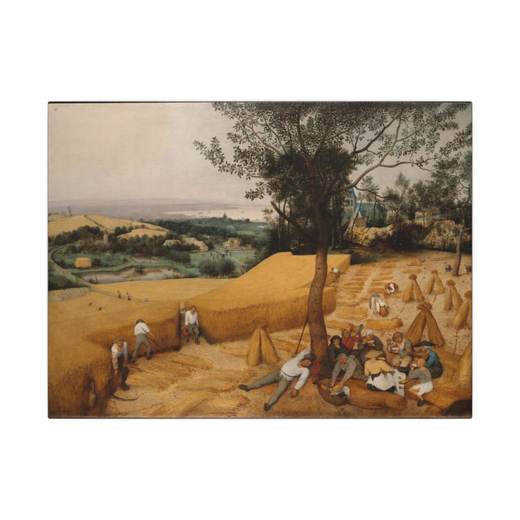
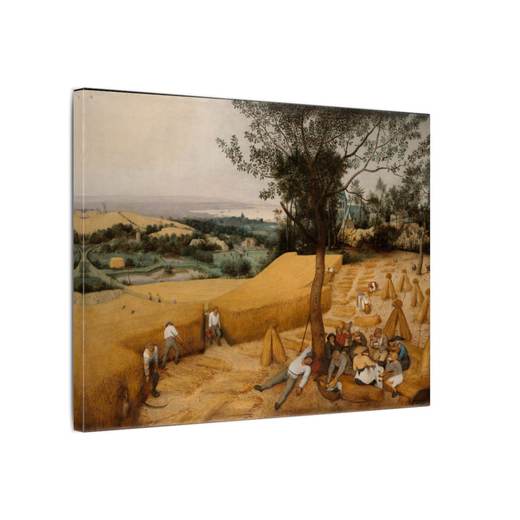
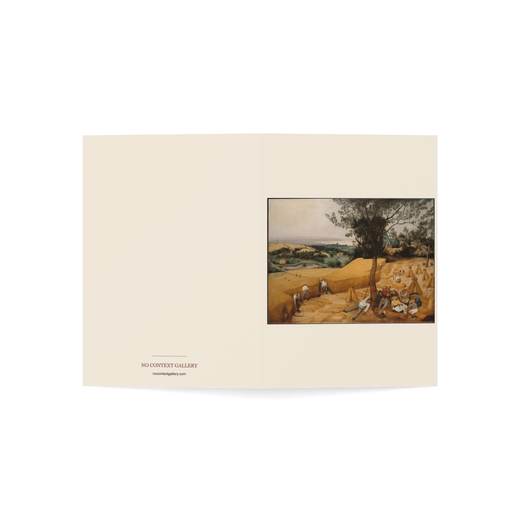
Pieter Bruegel the Elder painted The Harvesters in 1565 in oil on an oak panel. It belonged to six large paintings representing the seasons, commissioned for Antwerp merchant Niclaes Jongelinck, who owned at least sixteen Bruegels; five seasonal panels survive. The cycle grew from medieval Labors of the Months traditions, but Bruegel made landscape and everyday activity its principal subjects. Thin, luminous oil layers leave parts of the preparatory drawing visible, while thicker strokes sharpen selected details.
The world around it
Bruegel worked in the southern Netherlands in the aftermath of the Reformation, when religious division, international trade, print culture, and urban patrons were reshaping art. Although later audiences treated him simply as a painter of peasants, his patrons included scholars, humanists, and wealthy businessmen. In the Seasons, he removed the customary religious pretext for a panoramic landscape and focused on nature's recurring transformations. Rural labor entered an elite Antwerp interior not as an idyll, but as an observed world of work, appetite, fatigue, weather, and distance.
A detail to notice
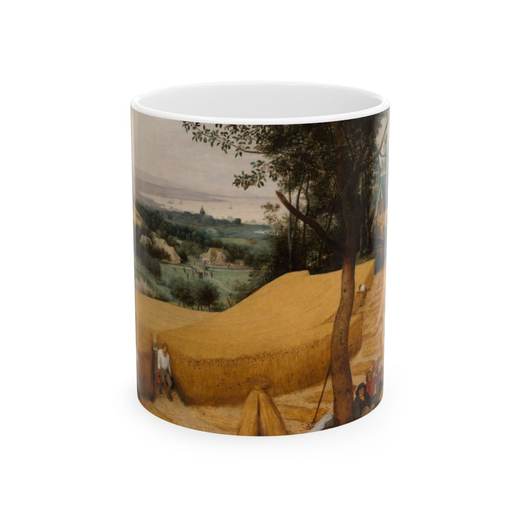
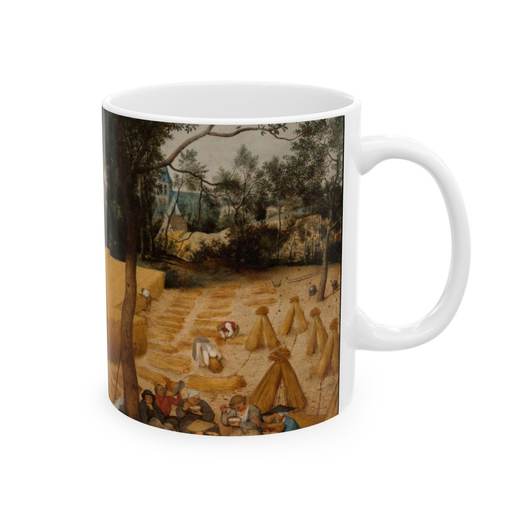
The painting probably represents August and September. Reapers cut the standing wheat at left and bind conical sheaves at right, while a group pauses beneath a pear tree. One exhausted man lies open-mouthed against the trunk; another turns to cut bread, and companions spoon food from bowls, drink, and talk. Their rest is not separated from labor: a rake leans against the tree, scythes echo the land's curves, and a bent woman repeats a sheaf's triangular shape. Golden fields descend through cooler green villages toward a hazy harbor where tiny boats raise sails. Distant figures appear to play, so the day expands beyond harvest. Bruegel makes the panorama larger than any worker, yet its gestures make that immense seasonal cycle humanly recognizable.
Look closer: materials, scale, and subjects
The recorded object is painting made in Oil on oak and held in the European Paintings department.
Recorded dimensions include Overall, including added strips at top, bottom, and right, 46 7/8 x 63 3/4 in. (119 x 162 cm); original painted surface 45 7/8 x 62 7/8 in. (116.5 x 159.5 cm).
Subject terms include Food, Men, Women, Landscapes, Working, and Eating. Treat them as guideposts, not a complete interpretation.
Collection history and public-domain source
The collection credit line is Rogers Fund, 1919.
The individual artwork page and official image were verified as Public Domain on 2026-08-23.
No Context Gallery independently uses the public-domain image. The source museum has not endorsed, sponsored, or affiliated itself with these products.
Research sources
See the products currently available with this artwork. Product choices appear only when the exact item is published, in stock, and available to purchase.