Artwork story
About Man in Prayer
The artist and artwork
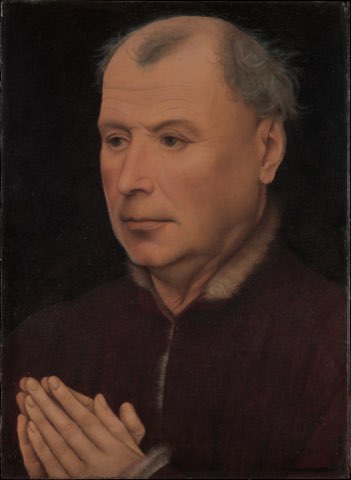
Man in Prayer was painted around 1440 in oil on wood by an artist in the workshop of Rogier van der Weyden. Rogier, born in Tournai around 1399, settled in Brussels and directed one of the most influential painting workshops in fifteenth-century Europe. The Met marks the attribution with a question, so the panel should not be presented as a securely documented work by Rogier's own hand. The unknown sitter turns slightly to his left and joins his hands. His cropped hair, fur-trimmed garment, and lit face emerge from a nearly black background.
The world around it
The panel belongs to the Burgundian Netherlands under Philip the Good, when Brussels, Bruges, Ghent, and Leuven connected an ambitious court with merchants, religious institutions, and international trade. Rogier served as Brussels's city painter and also made portraits for the Burgundian court. In the same world, religious practice created demand for small painted diptychs and triptychs that could be used in a home or private chapel. A patron could see his own likeness facing Christ, the Virgin, or a saint, turning prayer into a permanent painted encounter. Early Netherlandish oil technique made both sacred figures and living sitters feel vividly present.
A detail to notice
The picture's most important feature is something no longer there. The man's sideways gaze and clasped hands show that he once contemplated a devotional image on an adjacent panel, now missing. What survives is therefore one half of a visual conversation. Details intensify that prayer: the nuanced mouth, horizontal age lines across the brow, and tiny strokes of white stubble along the sitter's left cheek. Those unidealized marks make him feel near, while the dark background removes every distraction. The uncertain workshop attribution adds a second question: we can recognize Rogier's style and devotional design without knowing which painter in the workshop executed the panel.
Look closer: materials, scale, and subjects
The recorded object is painting made in Oil on wood and held in the European Paintings department.
Recorded dimensions include Overall 12 1/2 x 9 1/8 in. (31.8 x 23.2 cm); painted surface 12 1/2 x 9 in. (31.8 x 23 cm).
Subject terms include Men and Portraits. Treat them as guideposts, not a complete interpretation.
Collection history and public-domain source
The collection credit line is Bequest of Mary Stillman Harkness, 1950.
The individual artwork page and official image were verified as Public Domain on 2026-08-23T20:04:15.766Z.
No Context Gallery independently uses the public-domain image. The source museum has not endorsed, sponsored, or affiliated itself with these products.
Research sources
See the products currently available with this artwork. Product choices appear only when the exact item is published, in stock, and available to purchase.