Artwork story
About The Nymph of Fontainebleau
The artist and artwork
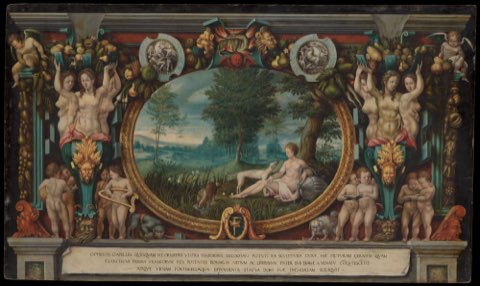
The Nymph of Fontainebleau was painted in oil on wood by an unidentified French artist associated with the School of Fontainebleau. The Met currently places it in the third quarter of the sixteenth century. The reclining nymph derives from a celebrated engraving by Pierre Milan and René Boyvin after a composition by the Florentine artist Rosso Fiorentino. The oval landscape sits inside an elaborate architectural frame.
The world around it
The image belongs to the cultural world Francis I created at Fontainebleau. After returning from captivity in 1527, the French king transformed a hunting lodge into a palace and recruited Italian artists, including Rosso Fiorentino and Francesco Primaticcio. Rosso had fled Rome after the city's violent sack that same year. At the French court, Italian Mannerist bodies, mythological subjects, stucco, painting, and carved ornament merged into a new decorative language. Prints helped those designs travel beyond palace rooms.
A detail to notice
The subject turns a place-name legend into an image. According to the story recorded by The Met, a royal hound named Bilaud discovered a spring while chasing a stag; the “font of Bilaud” was eventually shortened to Fontainebleau. In the central oval, the reclining nude personifies that water, while the stag, hound, reeds, trees, and stream preserve clues to the tale. The surrounding frame nearly competes with the landscape: paired female caryatids, putti, fruit garlands, round medallions, masks, and a long inscription fill the surface. That visual abundance also reveals how the design moved between media. Rosso's palace composition inspired a large engraving, the engraving circulated widely, and this unnamed painter translated it back into color on wood. A lost or altered court design could therefore survive through a chain of reproduction, architecture to print to painting, centuries before modern merchandise carried images into new settings.
Look closer: materials, scale, and subjects
The recorded object is painting made in Oil on wood and held in the European Paintings department.
Recorded dimensions include 26 x 47 3/4 in. (66 x 121.3 cm).
Subject terms include Books, Fruit, Heads, Reading, Dragons, and Nymphs. Treat them as guideposts, not a complete interpretation.
Collection history and public-domain source
The collection credit line is Gift of Mrs. Heyward Cutting, 1942.
The individual artwork page and official image were verified as Public Domain on 2026-08-23.
No Context Gallery independently uses the public-domain image. The source museum has not endorsed, sponsored, or affiliated itself with these products.
Research sources
See the products currently available with this artwork. Product choices appear only when the exact item is published, in stock, and available to purchase.