Artwork story
About Portrait of a Woman
The artist and artwork
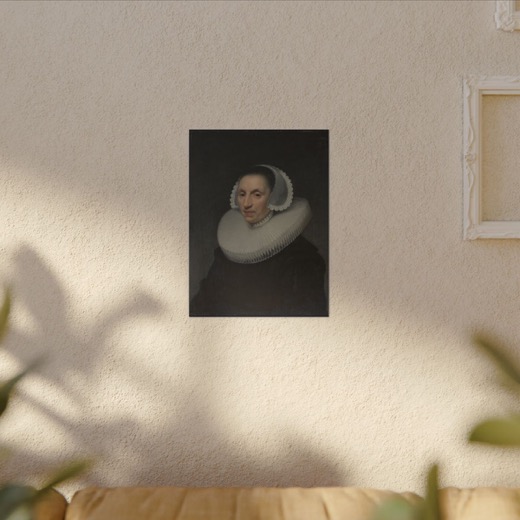
Jan van Ravesteyn painted Portrait of a Woman in 1635 in oil on a wood panel. The Met identifies the Dutch artist as born at Culemborg, probably around 1572, and dying at The Hague in 1657. He gives the unidentified sitter a nearly life-size presence, using smooth facial modeling and controlled whites to separate her from the dark ground. The formal likeness makes age and individual expression impossible to overlook.
The world around it
The portrait belongs to the Dutch Republic during the Eighty Years' War, thirteen years before Spain formally recognized Dutch independence in 1648. The Hague was both a court city and a center of government, and portraits made there could retain an unusually conservative formality. The Met notes that early-seventeenth-century portraits in The Hague and nearby Delft followed a tradition reaching back to sixteenth-century Spanish royal portraiture. Against expanding Dutch trade and social mobility, a sober painted likeness let prosperous sitters present discipline, family standing, and durable respectability rather than theatrical action.
A detail to notice
White linen does most of the visual work. A broad millstone ruff forms a luminous oval around the sitter, its narrow pleats carefully repeated but never mechanical. Her close cap rises into translucent side wings edged with tiny lace loops, and a second lace band traces her neck. Black clothing merges with the background so that face and linen float forward. Ravesteyn does not erase time: fine creases cross the forehead and gather beside the eyes and mouth, while restrained lips and lifted brows create an alert, assessing expression. At upper right, a faint signed-and-dated inscription is almost absorbed by the dark paint. The panel's worn edges and vertical join remain visible. These facts turn a costume record into a surviving encounter, an unnamed woman, an identified painter, and the year 1635 held together on wood.
Look closer: materials, scale, and subjects
The recorded object is painting made in Oil on wood and held in the European Paintings department.
Recorded dimensions include 26 7/8 x 22 7/8 in. (68.3 x 58.1 cm).
Subject terms include Portraits and Women. Treat them as guideposts, not a complete interpretation.
Collection history and public-domain source
The collection credit line is Gift of Henry Goldman, 1912.
The individual artwork page and official image were verified as Public Domain on 2026-08-24.
No Context Gallery independently uses the public-domain image. The source museum has not endorsed, sponsored, or affiliated itself with these products.
Research sources
See the products currently available with this artwork. Product choices appear only when the exact item is published, in stock, and available to purchase.