Artwork story
About Self-Portrait
The artist and artwork
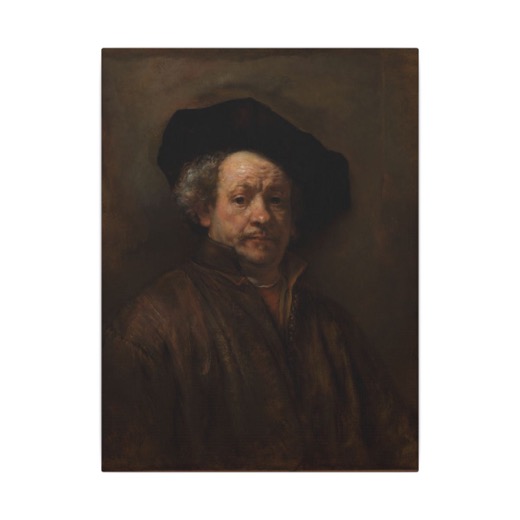
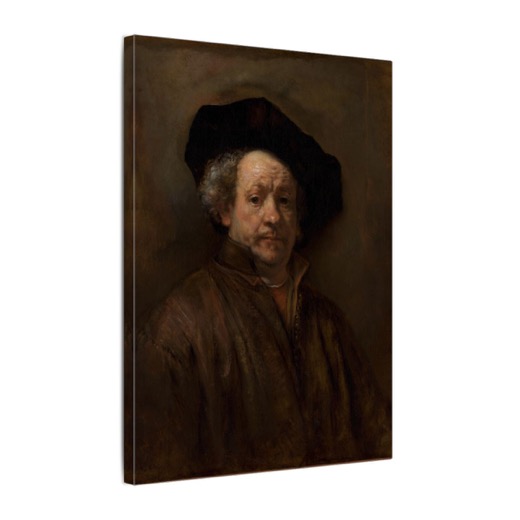
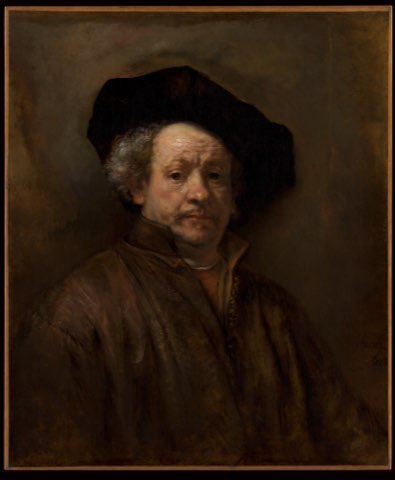
Rembrandt van Rijn painted this Self-Portrait in 1660, using oil on canvas. He was fifty-four and had long studied his face in paintings, drawings, and prints. Here he wears a broad dark cap and brown working clothes. Light gathers on his forehead, cheeks, nose, and eyes, while the torso is built from subdued strokes that dissolve into the brown ground.
The world around it
The picture belongs to the Dutch Golden Age, when Amsterdam's merchants and collectors supported a competitive art market. Rembrandt had been a celebrated painter in the city for decades, but this work came four years after he declared insolvency in 1656. The Met notes that he continued producing major works despite that collapse. His self-portraits were not simply private diary pages: likenesses of the famous master were prized by contemporary collectors, part of a European appetite for portraits of notable artists, writers, philosophers, and rulers. Personal scrutiny and public identity could occupy the same canvas.
A detail to notice
The face carries far more paint than the clothing. Pale ridges and raised touches catch shadows around the eyes, across the cheeks, and on the tip of the nose, making flesh seem modeled rather than smoothly described. The two eyes do not focus alike; Met curators have called one distracted or almost anxious. That imbalance prevents the expression from settling into a single mood. Wrinkles, soft skin, gray curls, and an uneven mouth are observed without flattery, yet the large cap gives the head monumental weight. At lower right, Rembrandt signed and dated the painting `Rembrandt / f. 1660`, asserting authorship inside this record of aging. The costume nearly disappears, but the built-up face remains physically present. Rather than stage wealth after bankruptcy, Rembrandt turns accumulated paint, sustained looking, and his recognizable features into the subject, and proof of his continuing authority as an artist.
Look closer: materials, scale, and subjects
The recorded object is painting made in Oil on canvas and held in the European Paintings department.
Recorded dimensions include 31 5/8 x 26 1/2 in. (80.3 x 67.3 cm).
Subject terms include Men and Self-portraits. Treat them as guideposts, not a complete interpretation.
Collection history and public-domain source
The collection credit line is Bequest of Benjamin Altman, 1913.
The individual artwork page and official image were verified as Public Domain on 2026-08-24.
No Context Gallery independently uses the public-domain image. The source museum has not endorsed, sponsored, or affiliated itself with these products.
Research sources
See the products currently available with this artwork. Product choices appear only when the exact item is published, in stock, and available to purchase.