Artwork story
About Portrait of a Man
The artist and artwork
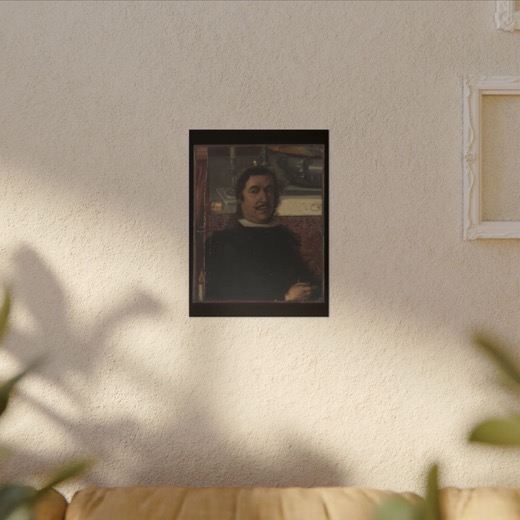
An unidentified Spanish painter, probably working in Andalusia in the late seventeenth century, made this Portrait of a Man in oil on canvas. What now looks like an independent likeness began as part of a larger religious painting. The sitter turns his mustached face toward us from a plain black garment and white collar, but the visible candlesticks, architectural furniture, patterned cloth, and partial hand still reveal the sacred setting from which his image was cut.
The world around it
The painting belongs to Spain's late Golden Age, when court portraiture and Catholic commissions were major fields of artistic work. Madrid painters valued the restrained tonality and loose, dry strokes that the Met recognizes here, a language associated with the naturalism and seemingly effortless handling made influential by Velázquez. The unknown sitter presumably paid for the original religious picture, so his likeness was not merely private documentation: placed near an altar, it could present patronage, devotion, and social standing together. Neither his name nor the original subject survives.
A detail to notice
The painting's most revealing feature is the evidence of its own alteration. Someone cut the man from a larger religious composition and then painted over the surrounding altarpiece and candlesticks to make the fragment pass as a self-contained portrait. Those elements are visible again, so broad pale bands, a red patterned textile, dark columns, metal candlesticks, and a carved form crowd behind the head. The lower-right hand stops abruptly at the cut edge. Instead of hiding damage, the surface lets us reconstruct two different objects: a donor inside a devotional scene and, later, a marketable portrait made by subtraction.
Look closer: materials, scale, and subjects
The recorded object is painting fragment made in Oil on canvas and held in the European Paintings department.
Recorded dimensions include 25 x 20 5/8 in. (63.5 x 52.4 cm).
Subject terms include Men and Portraits. Treat them as guideposts, not a complete interpretation.
Collection history and public-domain source
The collection credit line is The Friedsam Collection, Bequest of Michael Friedsam, 1931.
The individual artwork page and official image were verified as Public Domain on 2026-08-24.
No Context Gallery independently uses the public-domain image. The source museum has not endorsed, sponsored, or affiliated itself with these products.
Research sources
See the products currently available with this artwork. Product choices appear only when the exact item is published, in stock, and available to purchase.