Artwork story
About Portrait of a Man
The artist and artwork
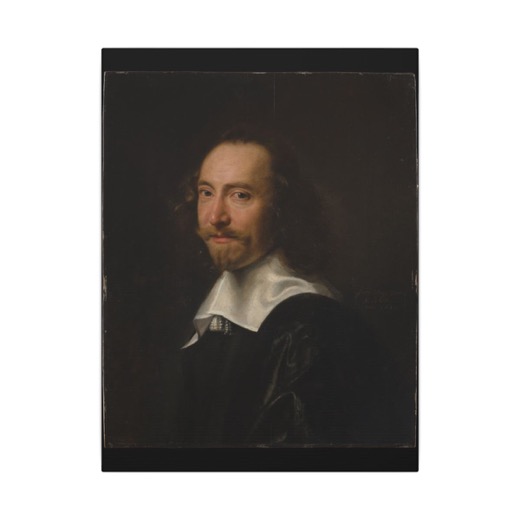
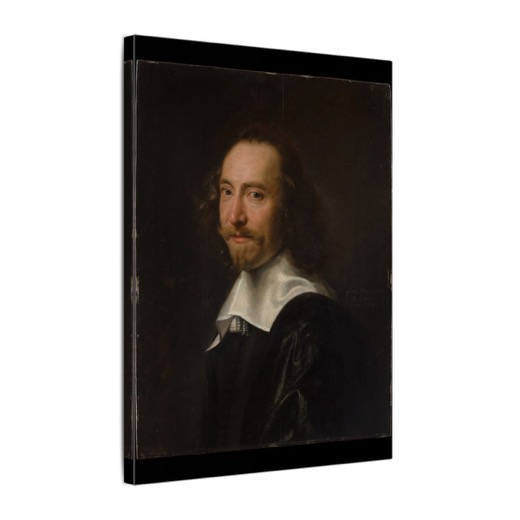
Abraham de Vries painted this Portrait of a Man in 1643, using oil on a wood panel. The Dutch painter probably worked in The Hague. He gives the unnamed sitter an alert gaze, long curling hair, a pointed beard, and a broad white collar above black clothing. Light gathers on the face, linen, and sleeve while the rest of the figure nearly merges with the dark background.
The world around it
The portrait belongs to the Dutch Golden Age, but it was made before the Dutch Republic's independence from Spain was formally recognized in 1648. The Met describes a competitive art market supported by civic institutions and prosperous private patrons, including merchants enriched by international trade. Portraits allowed members of that society to present likeness, clothing, bearing, and status without a royal or religious setting. The sober palette here concentrates attention on the sitter rather than possessions or scenery.
A detail to notice
The painting preserves its life as a physical object. Hairline joins and age cracks cross the wooden support; narrow worn edges remain visible; and a small inscription at lower right records De Vries and the year 1643. The sitter's bright left eye meets us first while his other eye turns slightly aside, creating an expression neither confrontational nor withdrawn. The white collar cuts a diagonal beneath the head, then disappears into a black satin sleeve built from barely lighter strokes. The work acquired a second public life in 1871, the year it entered the newly established Metropolitan Museum. French etcher Jules Jacquemart translated it into A Dutch Gentleman for the Museum's first print portfolio, one of ten reproductive etchings intended to circulate paintings from the founding collection. A quiet seventeenth-century likeness thus helped introduce a new American museum.
Look closer: materials, scale, and subjects
The recorded object is painting made in Oil on wood and held in the European Paintings department.
Recorded dimensions include 25 1/4 x 21 in. (64.1 x 53.3 cm).
Subject terms include Men and Portraits. Treat them as guideposts, not a complete interpretation.
Collection history and public-domain source
The collection credit line is Purchase, 1871.
The individual artwork page and official image were verified as Public Domain on 2026-08-24.
No Context Gallery independently uses the public-domain image. The source museum has not endorsed, sponsored, or affiliated itself with these products.
Research sources
See the products currently available with this artwork. Product choices appear only when the exact item is published, in stock, and available to purchase.