Artwork story
About The Repast of the Lion
The artist and artwork
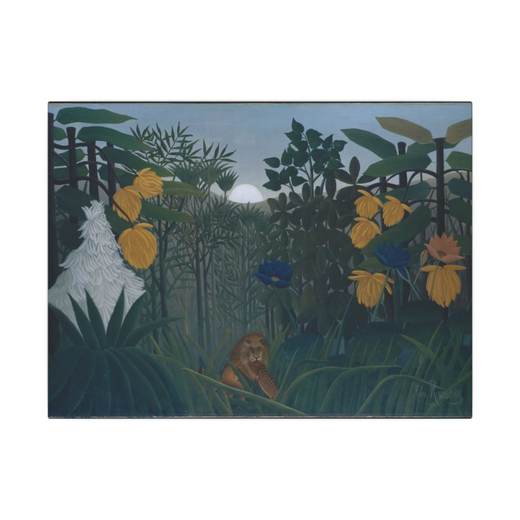
Henri Rousseau painted The Repast of the Lion around 1907 in oil on canvas. Called le Douanier because he had worked at a Paris tollgate, Rousseau was largely self-taught but pursued painting as his full occupation after 1893. He did not need a tropical expedition to construct this jungle. The Met records that he studied exotic plants in Paris botanical gardens and adapted wild animals from popular ethnographic journals and illustrated children's books, joining observed leaves to mediated beasts in a deliberately invented world.
The world around it
The picture was probably shown at the Salon d'Automne of 1907, one of the newer Paris exhibitions where modernist artists could challenge the authority of the old academic Salon. Only two years earlier, critics had labeled Matisse, Derain, and their vividly colored circle the Fauves, or “wild beasts,” after their Salon d'Automne display. Rousseau remained stylistically independent, yet his flat spaces, repeated contours, and improbable colors belonged to the same rapidly changing art world. A customs clerk's imagined jungle could stand beside experiments that were redefining modern painting.
A detail to notice
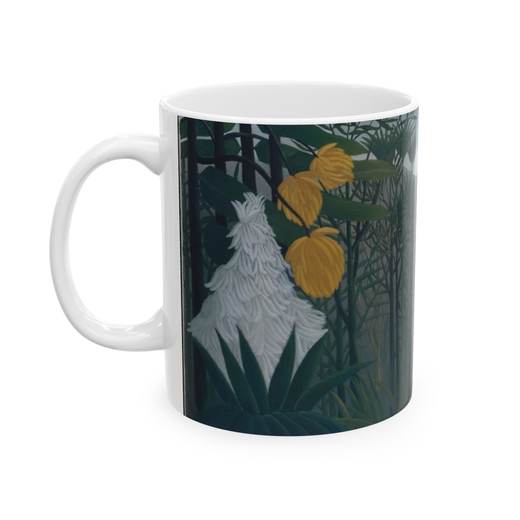
The lion and its spotted prey occupy only a small pocket at the lower center. Long blue-green leaves cross in front of their bodies, so the meal must be discovered beneath the picture's real abundance: black branching stems, overlapping oval leaves, thin palm fronds, enormous white and yellow blossoms, blue and orange flowers, and a pale disk on the horizon. Nothing obeys conventional scale. Plants press against every edge and rise like stage scenery, while openings between them create several shallow curtains rather than a natural forest. The title promises an animal drama, but Rousseau makes the act of searching through vegetation the viewer's first experience of it.
Look closer: materials, scale, and subjects
The recorded object is painting made in Oil on canvas and held in the European Paintings department.
Recorded dimensions include 44 3/4 in. × 63 in. (113.7 × 160 cm).
Subject terms include Lions and Forests. Treat them as guideposts, not a complete interpretation.
Collection history and public-domain source
The collection credit line is Bequest of Sam A. Lewisohn, 1951.
The individual artwork page and official image were verified as Public Domain on 2026-08-23.
No Context Gallery independently uses the public-domain image. The source museum has not endorsed, sponsored, or affiliated itself with these products.
Research sources
See the products currently available with this artwork. Product choices appear only when the exact item is published, in stock, and available to purchase.