Artwork story
About View from the Citadel Ramparts in Copenhagen by Moonlight
The artist and artwork
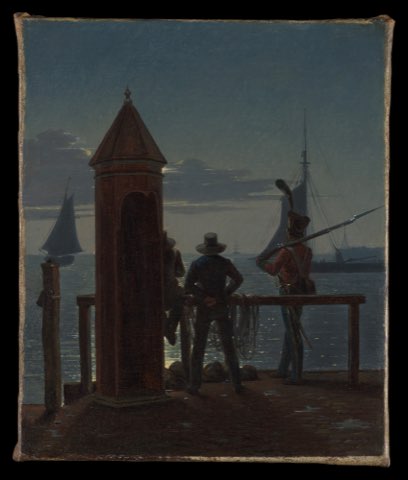
Martinus Rørbye painted View from the Citadel Ramparts in Copenhagen by Moonlight in 1839, using oil on a canvas only 11 3/8 by 9 5/8 inches. Rørbye was a Danish painter born in Drammen, Norway, and a student of maritime painter Christoffer Wilhelm Eckersberg. Here a soldier and two sailors stand on Copenhagen's Kastellet ramparts with their backs to us, looking across the harbor mouth.
The world around it
The work belongs to the period once called the Danish Golden Age, roughly 1800 to 1850, although Denmark had endured the Napoleonic Wars, the bombardment of Copenhagen, bankruptcy, territorial loss, and mounting conflict with Germany. By 1839 artists were using familiar landscapes and monuments to think about home and national identity as a formerly powerful kingdom became smaller and more politically unsettled. Kastellet was not a decorative ruin but an important military defense protecting the old city. Rørbye turns that battered strategic site into a quiet pause amid national upheaval.
A detail to notice
The moon itself is hidden behind the tall guard kiosk. We know it is there only from cool light on the figures, glowing clouds, and a narrow reflection across the water. That indirectness matters because The Met notes that moonlit scenes were rare in Danish Golden Age painting; artists more often preferred lucid daylight and restrained emotion. Rørbye borrows the Romantic device of figures seen from behind, inviting the viewer to share their looking without learning their identities. The armed, plumed soldier and the two sailors in broad hats have interrupted their duties, briefly becoming moonwatchers. On the far-left post, Rørbye placed his monogram and the date 1839, turning an ordinary part of the fortification into the painting's signature surface. The most luminous element is therefore never painted directly: absence organizes the whole scene.
Look closer: materials, scale, and subjects
The recorded object is painting made in Oil on canvas and held in the European Paintings department.
Recorded dimensions include 11 3/8 x 9 5/8 in. (28.9 x 24.4 cm).
Subject terms include Soldiers, Men, Night, and Ships. Treat them as guideposts, not a complete interpretation.
Collection history and public-domain source
The collection credit line is Gift of Eugene V. Thaw, 2007.
The individual artwork page and official image were verified as Public Domain on 2026-08-24.
No Context Gallery independently uses the public-domain image. The source museum has not endorsed, sponsored, or affiliated itself with these products.
Research sources
See the products currently available with this artwork. Product choices appear only when the exact item is published, in stock, and available to purchase.


