Artwork story
About Safavid Courtiers Leading Georgian Captives
The artist and artwork
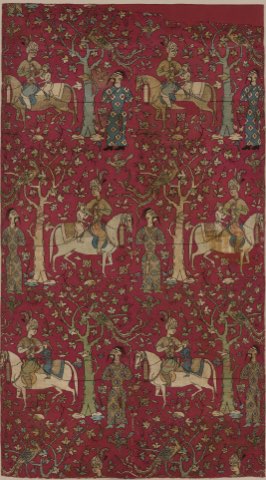
No individual designer or weaver is known for Safavid Courtiers Leading Georgian Captives, a mid-sixteenth-century Iranian silk textile. Its anonymous makers used lampas, a compound weave, to build riders, standing figures, horses, flowering plants, and birds directly into the cloth. Metal-wrapped thread supplied another luminous color. The result is not an image printed onto fabric: picture, surface, and luxury material were created together on the loom.
The world around it
The textile was made during the reign of Shah Tahmasp, when Safavid royal workshops served the court. Its subject is inseparable from that political world. The Met identifies the captives as Georgian nobles, women, and children seized during four Safavid military campaigns between 1540 and 1553. Rather than treating the scene as a neutral procession, it is important to recognize the unequal encounter it records: mounted Safavid courtiers lead people taken through war. A costly furnishing or garment fabric could therefore turn contemporary conquest into a repeated courtly image.
A detail to notice
The surviving fragment belongs to a group of thirteen related textiles, and repetition operates inside this piece as well. Across three horizontal registers, a mounted courtier and captive alternate with a standing attendant while trees and birds knit the episodes into one continuous red field. The same basic figures return, but changes in dress, gesture, horse color, and position keep the pattern from feeling mechanical. One material effect has nearly disappeared. The Met notes that metal-wrapped thread once embellished the top rider’s shirt and horse and the captive’s costume in the two lower rows. What now reads as a muted historical textile would originally have flashed as the cloth moved or caught light, luxury concentrated on both captors and captives within an image of forced movement.
Look closer: materials, scale, and subjects
The recorded object is panel made in Silk, metal wrapped thread; lampas and held in the Islamic Art department.
Recorded dimensions include Textile: L. 47 1/2 in. (120.7 cm); W. 26 1/2 in. (67.3 cm); Mount: L. 53 in. (134.6 cm); W. 32 1/8 in. (81.6 cm); D. 1 in. (2.5 cm); Wt. 31 lbs. (14.1 kg).
Subject terms include Birds, Children, Men, Horses, and Trees. Treat them as guideposts, not a complete interpretation.
Collection history and public-domain source
The collection credit line is Purchase, Joseph Pulitzer Bequest, 1952.
The individual artwork page and official image were verified as Public Domain on 2026-08-23.
No Context Gallery independently uses the public-domain image. The source museum has not endorsed, sponsored, or affiliated itself with these products.
Research sources
See the products currently available with this artwork. Product choices appear only when the exact item is published, in stock, and available to purchase.

