Artwork story
About "The Elephant Clock", Folio from a Book of the Knowledge of Ingenious Mechanical Devices by al-Jazari
The artist and artwork
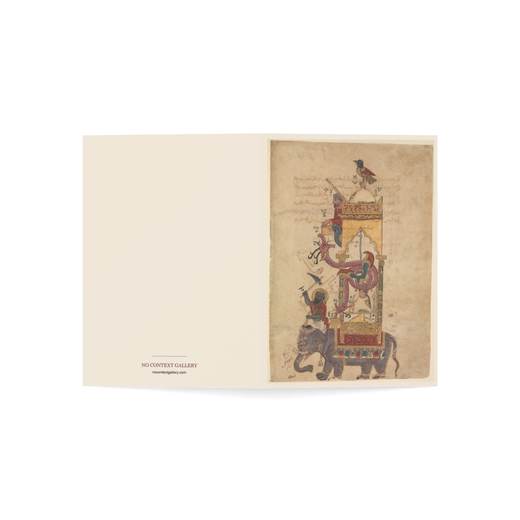
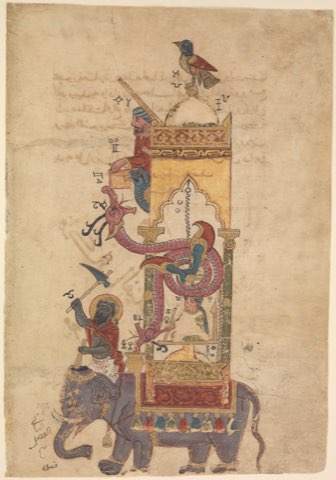
Farrukh ibn `Abd al-Latif transcribed this page in Syria in 715 AH/1315 CE, more than a century after the engineer al-Jazari completed his Book of the Knowledge of Ingenious Mechanical Devices in 1206. Made with ink, opaque watercolor, and gold on paper, the folio is both technical document and painted spectacle. Its apparatus stacks an elephant, driver, moving figures, dragons, a dome, and a bird into one readable machine. The page explains coordinated movement, sound, and timekeeping rather than merely recording a clock's appearance.
The world around it
The surviving copy belongs to the Mamluk period in Syria, when illustrated scientific manuscripts were increasingly popular but examples from this place and date remained rare. Al-Jazari had devised the machines while serving the Artuqid court in Diyar Bakr on the upper Tigris. His treatise joined practical engineering to princely entertainment, describing clocks, water-raising equipment, fountains, and automata through text and diagrams. Scholars and craftspeople worked within a connected Islamic world where Greek scientific traditions preserved in earlier manuscripts could be studied, adapted, and turned into new designs.
A detail to notice
The elephant clock announces each half hour through a theatrical chain reaction. The bird atop the dome whistles; a figure releases a ball into a dragon's mouth; the ball continues through the mechanism; and the mahout strikes the elephant with his goad. Other indicators show time through a pointer and changing openings beneath the dome. The animals and people are working components, not decoration applied after the engineering was solved. One falling ball links gravity, water regulation, sound, and movement. The painted page makes that hidden logic visible, allowing a reader to follow an automated performance centuries before animated public clocks.
Look closer: materials, scale, and subjects
The recorded object is folio from an illustrated manuscript made in Ink, opaque watercolor, and gold on paper and held in the Islamic Art department.
Recorded dimensions include H. 11 13/16 in. (30 cm); W. 7 3/4 in. (19.7cm); Mat: H. 19 1/4 in. (48.9 cm); W. 14 1/4 in. (36.2 cm); Frame: H. 20 1/4 in. (51.4 cm); W. 15 1/4 in. (38.7 cm).
Subject terms include Birds, Men, Dragons, Elephants, and Clocks. Treat them as guideposts, not a complete interpretation.
Collection history and public-domain source
The collection credit line is Bequest of Cora Timken Burnett, 1956.
The individual artwork page and official image were verified as Public Domain on 2026-08-23.
No Context Gallery independently uses the public-domain image. The source museum has not endorsed, sponsored, or affiliated itself with these products.
Research sources
See the products currently available with this artwork. Product choices appear only when the exact item is published, in stock, and available to purchase.