Artwork story
About The Feast of Herod and the Beheading of the Baptist
The artist and artwork
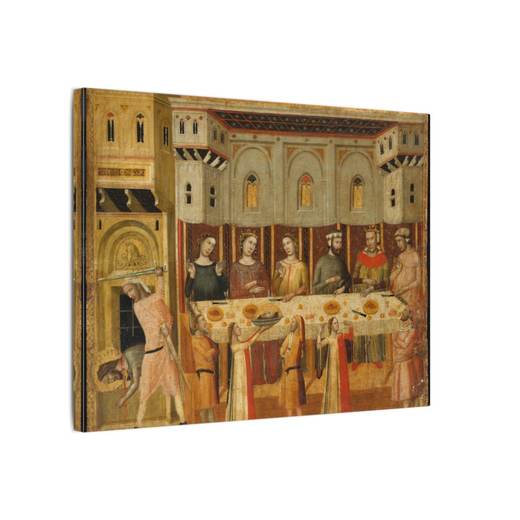
Giovanni Baronzio painted The Feast of Herod and the Beheading of the Baptist around 1330–35 in tempera on wood, gold ground, and silver. Active in Romagna and the Marches, Baronzio belonged to the Riminese school on Italy’s Adriatic coast. The Met calls this nearly twenty-inch-wide panel one of the most important surviving examples of fourteenth-century Riminese painting. It was one of eight scenes from a now-dismembered altarpiece devoted to the life of Saint John the Baptist.
The world around it
Baronzio worked during a decisive change in Italian painting. Gold-ground panels with roots in Byzantine visual tradition remained prominent, but Giotto’s volumetric figures, human emotion, and newly measurable pictorial space were transforming narrative art. Giotto had worked in Rimini early in the century, and The Met identifies his influence on the city’s painters. Wooden panels were then the principal support for portable paintings, from major church altarpieces to private devotional works. Workshops prepared seasoned planks with size, linen, and gesso before gilding and painting them in egg tempera, making Baronzio’s brilliant surface the result of an elaborate collective craft.
A detail to notice
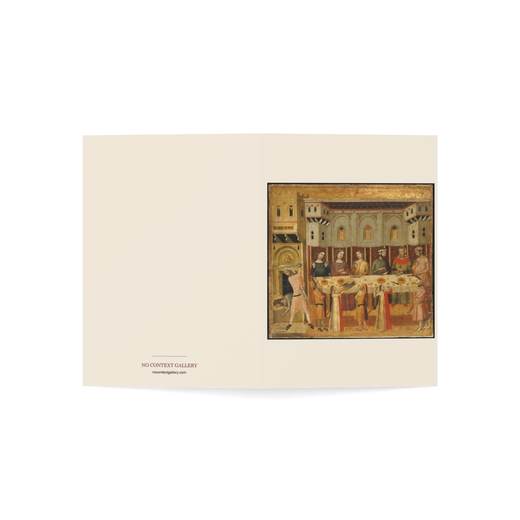
The panel makes several moments happen within one palace. At far left, an executioner raises his sword over Saint John’s body. Across the foreground, Salome appears first dancing before the crowned King Herod and then carrying John’s head on a platter to Queen Herodias. Architecture separates the actions without breaking them into different frames, so cause and consequence remain visible at once. Herod had promised his stepdaughter any wish after her dance; prompted by her mother, she asked for John’s head because the saint had criticized Herod’s marriage to his brother’s wife. This compact drama once belonged to a larger eight-panel cycle that may have flanked a Madonna and Child; its surviving companion scenes are now dispersed among museums and private collections.
Look closer: materials, scale, and subjects
The recorded object is painting made in Tempera on wood, gold ground, and silver and held in the Robert Lehman Collection department.
Recorded dimensions include 17 3/8 x 19 5/8 in. (44.1 x 49.8 cm).
Subject terms include Heads, Men, Women, and Saint John the Baptist. Treat them as guideposts, not a complete interpretation.
Collection history and public-domain source
The collection credit line is Robert Lehman Collection, 1975.
The individual artwork page and official image were verified as Public Domain on 2026-08-23.
No Context Gallery independently uses the public-domain image. The source museum has not endorsed, sponsored, or affiliated itself with these products.
Research sources
See the products currently available with this artwork. Product choices appear only when the exact item is published, in stock, and available to purchase.