Artwork story
About Self-Portrait
The artist and artwork
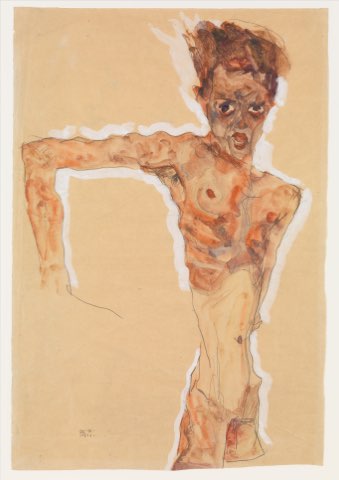
Egon Schiele made Self-Portrait in 1911 with watercolor, gouache, and graphite on tan paper. The Austrian artist was twenty-one years old and already treating his own body as a field for artistic experiment. He had looked to Gustav Klimt as a mentor and adopted the thin contour line associated with the older artist, but pushed it toward a harsher, more angular figure. Schiele made hundreds of paintings and thousands of works on paper during his brief career, returning repeatedly to self-portraiture as a way to test pose, identity, and emotional presence.
The world around it
The sheet belongs to Vienna just before the First World War, when the city became a center of radical cultural change. The Secession and the Wiener Werkstätte challenged academic taste; Sigmund Freud was developing psychoanalysis; Arnold Schoenberg and Anton Webern transformed musical composition; and architects including Adolf Loos and Josef Hoffmann proposed new forms for modern life. Schiele worked inside this atmosphere but did not copy its polished surfaces. His isolated, deliberately uncomfortable bodies replaced public decorum with exposure, tension, and subjective experience, helping define Austrian Expressionism.
A detail to notice
Schiele does not simply show his face. He thrusts one arm sideways and bends it sharply at the elbow in a pose that The Met compares to the crucified Christ. Wild hair, enlarged dark eyes, an open mouth, and an emaciated torso make the body feel electrically alert. Brown washes and graphite lines remain close to the tan paper, while red marks pick out the mouth, nipples, navel, and genitals. A jagged white gouache border surrounds the figure like a cutout, aura, or flash of light. The empty ground provides no room or story to soften the encounter, so pose, line, and exposed paper carry the complete psychological charge.
Look closer: materials, scale, and subjects
The recorded object is drawing made in Watercolor, graphite, and gouache on paper and held in the Modern and Contemporary Art department.
Recorded dimensions include 20 1/4 x 13 3/4 in. (51.4 x 34.9 cm).
Subject terms include Male Nudes and Self-portraits. Treat them as guideposts, not a complete interpretation.
Collection history and public-domain source
The collection credit line is Bequest of Scofield Thayer, 1982.
The individual artwork page and official image were verified as Public Domain on 2026-08-24.
No Context Gallery independently uses the public-domain image. The source museum has not endorsed, sponsored, or affiliated itself with these products.
Research sources
See the products currently available with this artwork. Product choices appear only when the exact item is published, in stock, and available to purchase.


