Artwork story
About Landscape
The artist and artwork
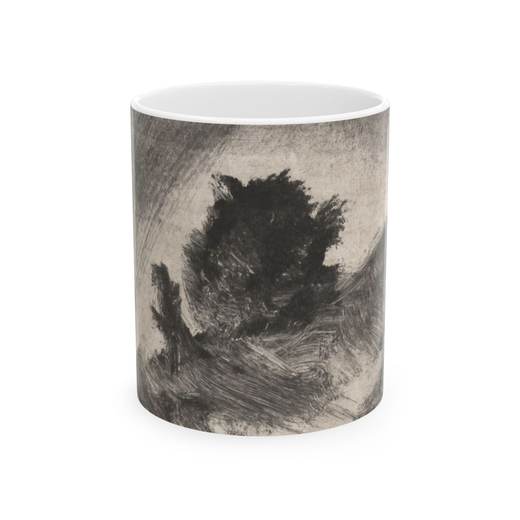
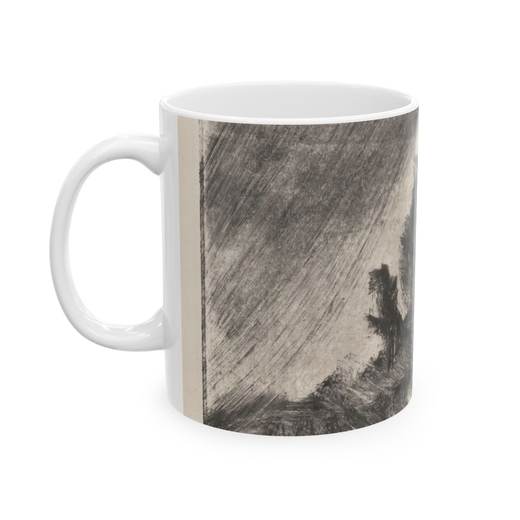
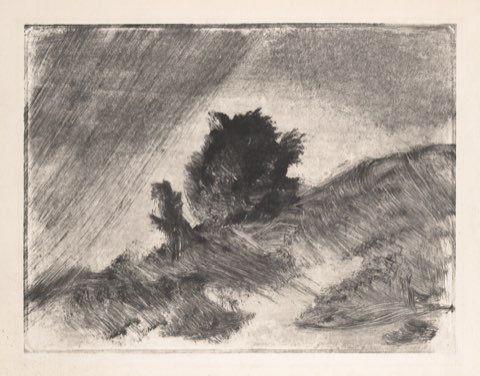
Edgar Degas made Landscape around 1877–79 as a monotype, a print created by manipulating ink on a smooth, unincised plate and taking an impression on paper. The academically trained Parisian became a founder and organizer of the independent exhibitions associated with Impressionism, although he preferred to call himself a Realist or Independent. He rarely painted landscapes outdoors but pursued fleeting effects through experimental media. Here black ink becomes a windswept hillside, a dense clump of trees or shrubs, and slanting weather rather than the ballet studios and urban interiors for which he is better known.
The world around it
The sheet emerged in a Paris still remaking itself after the Franco-Prussian War and the upheaval of 1870–71, during which Degas served in the city's defense. Independent artists challenged the official Salon through group exhibitions, including their third show in 1877, while boulevards, theaters, factories, the illustrated press, and consumer culture changed what art could treat seriously. Printmakers also reacted to mass-produced imagery by reviving hand-worked techniques. The Met notes a contradiction: graphic processes could be laborious, yet Degas and other Impressionists used them to pursue atmosphere and momentary sensation. Monotype suited that search because each inked plate could yield a singular, unstable image.
A detail to notice
The storm is both an experiment and an art-historical conversation. Degas formed rain from dramatic diagonal striations across the upper left and let rubbed, pooled, and dragged ink create rough ground below. The Met identifies a direct reference to Rembrandt's 1643 print The Three Trees, which Degas greatly admired. Rembrandt combined etching, engraving, drypoint, and plate tone to show nature in flux; more than two centuries later, Degas answered with broader smears and pressure marks. The central vegetation may be read as trees or shrubs, and that uncertainty matters: the print makes weather visible rather than cataloguing a place. Because a monotype normally produces one principal impression, this rainstorm is the singular surviving trace of ink arranged on a plate and transformed by printing.
Look closer: materials, scale, and subjects
The recorded object is print made in Monotype and held in the Drawings and Prints department.
Recorded dimensions include Plate: 6 5/16 × 8 5/16 in. (16.1 × 21.1 cm).
Collection history and public-domain source
The collection credit line is Purchase, The Derald H. Ruttenberg Foundation Gift, 2024.
The individual artwork page and official image were verified as Public Domain on 2026-08-23T20:04:15.766Z.
No Context Gallery independently uses the public-domain image. The source museum has not endorsed, sponsored, or affiliated itself with these products.
Research sources
See the products currently available with this artwork. Product choices appear only when the exact item is published, in stock, and available to purchase.